Advertisements
Advertisements
Question
Find the unknown side in the following triangles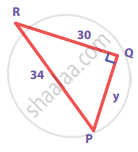
Advertisements
Solution
From ∆PQR, by Pythagoras theorem.
PR2 = PQ2 + QR2
342 = y2 + 302
⇒ y2 = 342 – 302
= 1156 – 900
= 256 = 162
y2 = 162
⇒ y = 16
APPEARS IN
RELATED QUESTIONS
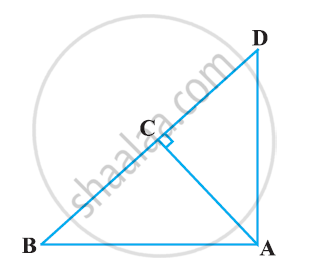
In Figure ABD is a triangle right angled at A and AC ⊥ BD. Show that AC2 = BC × DC
Prove that, in a right-angled triangle, the square of the hypotenuse is equal to the sum of the square of remaining two sides.
In triangle ABC, angle A = 90o, CA = AB and D is the point on AB produced.
Prove that DC2 - BD2 = 2AB.AD.
O is any point inside a rectangle ABCD.
Prove that: OB2 + OD2 = OC2 + OA2.
The top of a ladder of length 15 m reaches a window 9 m above the ground. What is the distance between the base of the wall and that of the ladder?
Find the Pythagorean triplet from among the following set of numbers.
4, 7, 8
If length of sides of a triangle are a, b, c and a2 + b2 = c2, then which type of triangle it is?
Foot of a 10 m long ladder leaning against a vertical wall is 6 m away from the base of the wall. Find the height of the point on the wall where the top of the ladder reaches.
A right-angled triangle may have all sides equal.
Two poles of 10 m and 15 m stand upright on a plane ground. If the distance between the tops is 13 m, find the distance between their feet.
