Advertisements
Advertisements
Question
In triangle ABC, line I, is a perpendicular bisector of BC.
If BC = 12 cm, SM = 8 cm, find CS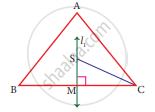
Advertisements
Solution
Given l1, is the perpendicular bisector of BC.
∴ ∠SMC = 90°and BM = MC
BC = 12 cm
⇒ BM + MC = 12 cm
MC + MC = 12 cm
2MC = 12
MC = `12/2`
MC = 6 cm
Given SM = 8 cm
By Pythagoras theorem SC2 = SM2 + MC2
SC2 = 82 + 62
SC2 = 64 + 36
CS2 = 100
CS2 = 102
CS = 10 cm
APPEARS IN
RELATED QUESTIONS
Two towers of heights 10 m and 30 m stand on a plane ground. If the distance between their feet is 15 m, find the distance between their tops
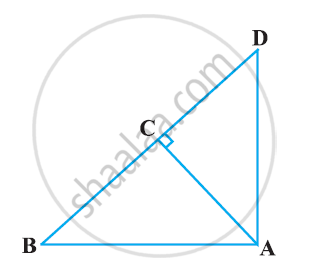
In Figure, ABD is a triangle right angled at A and AC ⊥ BD. Show that AD2 = BD × CD
The sides of a certain triangle is given below. Find, which of them is right-triangle
6 m, 9 m, and 13 m
In the figure below, find the value of 'x'.
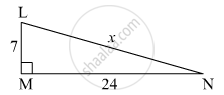
Find the Pythagorean triplet from among the following set of numbers.
9, 40, 41
A right triangle has hypotenuse p cm and one side q cm. If p - q = 1, find the length of third side of the triangle.
In a triangle ABC right angled at C, P and Q are points of sides CA and CB respectively, which divide these sides the ratio 2 : 1.
Prove that: 9AQ2 = 9AC2 + 4BC2
In a triangle ABC right angled at C, P and Q are points of sides CA and CB respectively, which divide these sides the ratio 2 : 1.
Prove that : 9(AQ2 + BP2) = 13AB2
PQR is an isosceles triangle with PQ = PR = 10 cm and QR = 12 cm. Find the length of the perpendicular from P to QR.
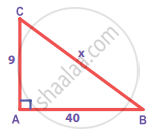
Find the unknown side in the following triangles