Advertisements
Advertisements
प्रश्न
In triangle ABC, line I, is a perpendicular bisector of BC.
If BC = 12 cm, SM = 8 cm, find CS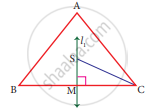
Advertisements
उत्तर
Given l1, is the perpendicular bisector of BC.
∴ ∠SMC = 90°and BM = MC
BC = 12 cm
⇒ BM + MC = 12 cm
MC + MC = 12 cm
2MC = 12
MC = `12/2`
MC = 6 cm
Given SM = 8 cm
By Pythagoras theorem SC2 = SM2 + MC2
SC2 = 82 + 62
SC2 = 64 + 36
CS2 = 100
CS2 = 102
CS = 10 cm
APPEARS IN
संबंधित प्रश्न
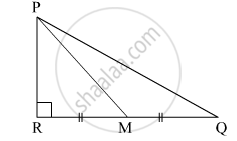
In the given figure, M is the midpoint of QR. ∠PRQ = 90°. Prove that, PQ2 = 4PM2 – 3PR2.
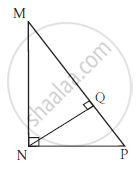
In ΔMNP, ∠MNP = 90˚, seg NQ ⊥ seg MP, MQ = 9, QP = 4, find NQ.
A man goes 40 m due north and then 50 m due west. Find his distance from the starting point.
The sides of a certain triangle is given below. Find, which of them is right-triangle
6 m, 9 m, and 13 m
In the given figure, angle ACB = 90° = angle ACD. If AB = 10 m, BC = 6 cm and AD = 17 cm, find :
(i) AC
(ii) CD
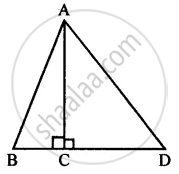
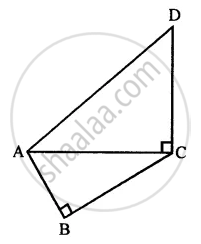
In the given figure, AD = 13 cm, BC = 12 cm, AB = 3 cm and angle ACD = angle ABC = 90°. Find the length of DC.
Find the unknown side in the following triangles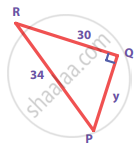
In a quadrilateral ABCD, ∠A + ∠D = 90°. Prove that AC2 + BD2 = AD2 + BC2
[Hint: Produce AB and DC to meet at E.]
In a right-angled triangle ABC, if angle B = 90°, then which of the following is true?
The foot of a ladder is 6 m away from its wall and its top reaches a window 8 m above the ground. If the ladder is shifted in such a way that its foot is 8 m away from the wall, to what height does its top reach?
