हिंदी

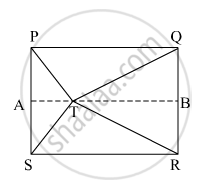
In the given figure, point T is in the interior of rectangle PQRS, Prove that, TS2 + TQ2 = TP2 + TR2 (As shown in the figure, draw seg AB || side SR and A-T-B) - Geometry Mathematics 2
Advertisements
Advertisements

प्रश्न

In the given figure, point T is in the interior of rectangle PQRS, Prove that, TS+ TQ= TP+ TR(As shown in the figure, draw seg AB || side SR and A-T-B)

योग
Advertisements

उत्तर १

Construction: Through T, draw seg AB II side SR such that A-T-B, P- A-S and Q-B-R.

Proof:

seg PS || seg QR   ...(Opposite sides of rectangle)

∴ seg AS || seg BR   ...(P-A-S and Q-B-R)

also seg AB || seg SR   ...(Construction)

∴ `square` ASRB is a parallelogram   ...((By definition)

∠ASR = 90°   ...(Angle of rectangle PSRQ)

∴ `square` ASRB is a rectangle   ...(A parallelogram is a rectangle, if one of its angles is a right angle.)

∠SAB = ∠ABR = 90°   ...(Angle of a rectangle)

∴ seg TA ⊥ side PS and seg TB ⊥ side QR   ...(1)

AS = BR   ...(2) (Opposite sides of rectangle are equal)

Similarly, we can prove AP= BQ   ...(3)

In ΔTAS,

∠TAS = 90°   ...[From (1)]

∴ by Pythagoras theorem,

TS2 = TA2 + AS2   ...(4)

In ΔTBQ,

∠TBQ = 90°   ...[From (1)]

∴ by Pythagoras theorem,

TQ2 = TB2 + BQ2   ...(5)

Adding (4) and (5), we get,

TS2 + TQ2 = TA2 + AS2 + TB2 + BQ  ...(6)

In ΔTAP,

∠TAP = 90°   ...[From (1)]

∴ by Pythagoras theorem,

TP2 = TA2 + AP2   ...(7)

In ΔTBR,

∠TBR = 90°   ...[From (1)]

∴ by Pythagoras theorem,

TR2 = TB2 + BR2   ...(8)

Adding (7) and (8), we get

TP2 + TR2 = TA2 + AP2 + TB2 + BR2

∴ TP2 + TR2 = TA2 + BQ2 + TB2 + AS2   ...(9) [From (2) and (3)]

∴ from (6) and (g), we get,

TS2 + TQ2 = TP2 + TR2

shaalaa.com

उत्तर २

Construction: Draw diagonals PR and QS and let them intersect at 0. Draw seg TO.

Proof: `square` PQRS is a rectangle   ...(Given)

∴ PR=QS   ...(Diagonals of rectangle are congruent)

Multiplying both the sides by `1/2`, we get,

`1/2`PR = `1/2`QS   ...(1)

But, `1/2`PR = OP = OR   ...(2)

and `1/2`QS = OS = OQ   ...(3) [Diagonals of rectangle bisect each other]

∴ OP = OR = OS = OQ   ...(4) [From (1), (2) and (3)]

In ΔTSQ,

seg TO is the median   ...(By definition)

∴ by Apollonius theorem,

TS2 + TQ2 = 2TO2 + 2OQ2   ...(5)

In ΔPTR,

seg TO is the median   ...(By definition)

∴ by Apollonius theorem,

TP2 + TR2 = 2TO2 + 2OR2

∴ TP2 + TR2 = 2TO2 + 2OQ2   ...(6) [From (4)]

∴ from (5) and (6), we get,

TS2 + TQ2 = TP2 + TR2

shaalaa.com

Notes

Students can refer to the provided solutions based on their preferred marks.

  क्या इस प्रश्न या उत्तर में कोई त्रुटि है?
अध्याय 2: Pythagoras Theorem - Practice Set 2.2 [पृष्ठ ४३]

APPEARS IN

बालभारती Mathematics 2 [English] Standard 10 Maharashtra State Board
अध्याय 2 Pythagoras Theorem
Practice Set 2.2 | Q 5 | पृष्ठ ४३

वीडियो ट्यूटोरियलVIEW ALL [1]

संबंधित प्रश्न

From a point O in the interior of a ∆ABC, perpendicular OD, OE and OF are drawn to the sides BC, CA and AB respectively. Prove
that :

`(i) AF^2 + BD^2 + CE^2 = OA^2 + OB^2 + OC^2 – OD^2 – OE^2 – OF^2`

`(ii) AF^2 + BD^2 + CE^2 = AE^2 + CD^2 + BF^2`


A ladder 10 m long reaches a window 8 m above the ground. Find the distance of the foot of the ladder from base of the wall.


D and E are points on the sides CA and CB respectively of a triangle ABC right angled at C. Prove that AE+ BD2 = AB2 + DE2


A 15 m long ladder reached a window 12 m high from the ground on placing it against a wall at a distance a. Find the distance of the foot of the ladder from the wall.


Prove that, in a right-angled triangle, the square of the hypotenuse is equal to the sum of the square of remaining two sides.


Identify, with reason, if the following is a Pythagorean triplet.
(4, 9, 12)


Find the side and perimeter of a square whose diagonal is 10 cm.


In right angle ΔABC, if ∠B = 90°, AB = 6, BC = 8, then find AC.


In the given figure, angle BAC = 90°, AC = 400 m, and AB = 300 m. Find the length of BC.


In the given figure, angle ACP = ∠BDP = 90°, AC = 12 m, BD = 9 m and PA= PB = 15 m. Find:
(i) CP
(ii) PD
(iii) CD


In the given figure, angle ACB = 90° = angle ACD. If AB = 10 m, BC = 6 cm and AD = 17 cm, find :
(i) AC
(ii) CD


A boy first goes 5 m due north and then 12 m due east. Find the distance between the initial and the final position of the boy.


In the right-angled ∆PQR, ∠ P = 90°. If l(PQ) = 24 cm and l(PR) = 10 cm, find the length of seg QR.


The top of a ladder of length 15 m reaches a window 9 m above the ground. What is the distance between the base of the wall and that of the ladder?


From a point O in the interior of aΔABC, perpendicular OD, OE and OF are drawn to the sides BC, CA and AB respectively. Prove that: AF2 + BD2 + CE= OA2 + OB2 + OC2 - OD2 - OE2 - OF2


To get from point A to point B you must avoid walking through a pond. You must walk 34 m south and 41 m east. To the nearest meter, how many meters would be saved if it were possible to make a way through the pond?


In the given figure, ∠T and ∠B are right angles. If the length of AT, BC and AS (in centimeters) are 15, 16, and 17 respectively, then the length of TC (in centimeters) is ______.


In figure, PQR is a right triangle right angled at Q and QS ⊥ PR. If PQ = 6 cm and PS = 4 cm, find QS, RS and QR.


In the adjoining figure, a tangent is drawn to a circle of radius 4 cm and centre C, at the point S. Find the length of the tangent ST, if CT = 10 cm.


Jayanti takes shortest route to her home by walking diagonally across a rectangular park. The park measures 60 metres × 80 metres. How much shorter is the route across the park than the route around its edges?


Share
Notifications

Englishहिंदीमराठी


      Forgot password?
Use app×