Advertisements
Advertisements
प्रश्न
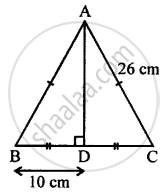
In the given figure, angle ADB = 90°, AC = AB = 26 cm and BD = DC. If the length of AD = 24 cm; find the length of BC.
Advertisements
उत्तर
Given:
∆ ABC
∠ADB = 90° and AC = AB = 26 cm
AD = 24 cm
To find : Length of BC In right angled ∆ ADC
AB = 26 cm, AD = 24 cm
According to Pythagoras Theorem,
(AC)2 = (AD)2 + (DC)2
(26)2 = (24)2 + (DC)2
676 = 576 + (DC)2
⇒ (DC)2 = 100
⇒ DC =`sqrt100` = 10 cm
∴ Length of BC = BD + DC
= 10 + 10 = 20 cm
APPEARS IN
संबंधित प्रश्न
A man goes 10 m due east and then 24 m due north. Find the distance from the starting point
Prove that, in a right-angled triangle, the square of the hypotenuse is equal to the sum of the square of remaining two sides.
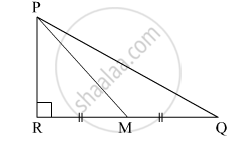
In the given figure, M is the midpoint of QR. ∠PRQ = 90°. Prove that, PQ2 = 4PM2 – 3PR2.
In the given figure, ∠B = 90°, XY || BC, AB = 12 cm, AY = 8cm and AX : XB = 1 : 2 = AY : YC.
Find the lengths of AC and BC.

Find the length of diagonal of the square whose side is 8 cm.
In the figure below, find the value of 'x'.
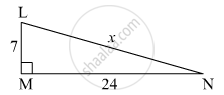
Find the length of the hypotenuse of a triangle whose other two sides are 24cm and 7cm.
∆ABC is right-angled at C. If AC = 5 cm and BC = 12 cm. find the length of AB.
In an isosceles triangle PQR, the length of equal sides PQ and PR is 13 cm and base QR is 10 cm. Find the length of perpendicular bisector drawn from vertex P to side QR.
Jiya walks 6 km due east and then 8 km due north. How far is she from her starting place?
