Advertisements
Advertisements
प्रश्न
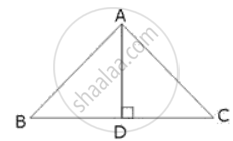
AD is perpendicular to the side BC of an equilateral ΔABC. Prove that 4AD2 = 3AB2.
Advertisements
उत्तर

In equilateral triangle AD ⊥ BC.
⇒ BD = DC = `"BC"/(2)` ...(In equilateral triangle altitude bisects the opposite side)
In right triangle ABD,
AB2 = AD2 + BD2
= `"AD"^2 + ("BC"/2)^2`
= `(4"AD"^2 + "BC"^2)/(4)`
= `(4"AD"^2 + "BC"^2)/(4)` ...(Since AB = BC)
⇒ 4AB2 = 4AD2 + AB2
⇒ 3AB2 = 4AD2
Hence proved..
APPEARS IN
संबंधित प्रश्न
The diagonal of a rectangular field is 16 metres more than the shorter side. If the longer side is 14 metres more than the shorter side, then find the lengths of the sides of the field.
In the given figure, ∆ABC is an obtuse triangle, obtuse-angled at B. If AD ⊥ CB (produced) prove that AC2 = AB2 + BC2 + 2BC · BD.

In Figure, ABD is a triangle right angled at A and AC ⊥ BD. Show that AB2 = BC × BD

Prove that, in a right-angled triangle, the square of the hypotenuse is equal to the sum of the square of remaining two sides.
Identify, with reason, if the following is a Pythagorean triplet.
(11, 60, 61)
For finding AB and BC with the help of information given in the figure, complete following activity.
AB = BC .......... 
∴ ∠BAC = 
∴ AB = BC =
× AC
=
× `sqrt8`
=
× `2sqrt2`
= 

Find the side and perimeter of a square whose diagonal is 10 cm.
In ∆PQR, point S is the midpoint of side QR. If PQ = 11, PR = 17, PS = 13, find QR.
In the given figure, point T is in the interior of rectangle PQRS, Prove that, TS2 + TQ2 = TP2 + TR2 (As shown in the figure, draw seg AB || side SR and A-T-B)

AD is drawn perpendicular to base BC of an equilateral triangle ABC. Given BC = 10 cm, find the length of AD, correct to 1 place of decimal.
Find the length of the perpendicular of a triangle whose base is 5cm and the hypotenuse is 13cm. Also, find its area.
From a point O in the interior of aΔABC, perpendicular OD, OE and OF are drawn to the sides BC, CA and AB respectively. Prove that: AF2 + BD2 + CE2 = AE2 + CD2 + BF2
In a triangle ABC, AC > AB, D is the midpoint BC, and AE ⊥ BC. Prove that: AC2 = AD2 + BC x DE + `(1)/(4)"BC"^2`
In a square PQRS of side 5 cm, A, B, C and D are points on sides PQ, QR, RS and SP respectively such as PA = PD = RB = RC = 2 cm. Prove that ABCD is a rectangle. Also, find the area and perimeter of the rectangle.
If ‘l‘ and ‘m’ are the legs and ‘n’ is the hypotenuse of a right angled triangle then, l2 = ________
In the given figure, ∠T and ∠B are right angles. If the length of AT, BC and AS (in centimeters) are 15, 16, and 17 respectively, then the length of TC (in centimeters) is ______.

Is the triangle with sides 25 cm, 5 cm and 24 cm a right triangle? Give reasons for your answer.
Foot of a 10 m long ladder leaning against a vertical wall is 6 m away from the base of the wall. Find the height of the point on the wall where the top of the ladder reaches.
The longest side of a right angled triangle is called its ______.