हिंदी

ABC is a triangle, right-angled at B. M is a point on BC. Prove that: AM2 + BC2 = AC2 + BM2 - Mathematics

Advertisements
Advertisements

प्रश्न

ABC is a triangle, right-angled at B. M is a point on BC.

Prove that: AM2 + BC2 = AC2 + BM2

योग
Advertisements

उत्तर

The pictorial form of the given problem is as follows:
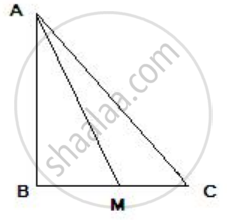
Pythagoras theorem states that in a right-angled triangle, the square on the hypotenuse is equal to the sum of the squares on the remaining two sides.

First, we consider the ΔABM and applying Pythagoras theorem we get,

AM2 = AB2 + BM2 

AB2 = AM2 - BM2               ...(i)

Now, we consider the ΔABC and applying Pythagoras theorem we get,

AC2 = AB2 + BC2 

AB2 = AC2 - BC2                ...(ii)

From (i) and (ii) we get,

AM2 - BM2 = AC2 - BC2 

AM2 + BC= AC2 + BM2  

Hence, Proved.

shaalaa.com
  क्या इस प्रश्न या उत्तर में कोई त्रुटि है?
अध्याय 13: Pythagoras Theorem [Proof and Simple Applications with Converse] - Exercise 13 (B) [पृष्ठ १६३]

APPEARS IN

सेलिना Concise Mathematics [English] Class 9 ICSE
अध्याय 13 Pythagoras Theorem [Proof and Simple Applications with Converse]
Exercise 13 (B) | Q 3 | पृष्ठ १६३

संबंधित प्रश्न

In triangle ABC, ∠C=90°. Let BC= a, CA= b, AB= c and let 'p' be the length of the perpendicular from 'C' on AB, prove that:

1. cp = ab

2. `1/p^2=1/a^2+1/b^2`


In a right triangle ABC, right-angled at B, BC = 12 cm and AB = 5 cm. The radius of the circle inscribed in the triangle (in cm) is
(A) 4
(B) 3
(C) 2
(D) 1


In a right triangle ABC right-angled at C, P and Q are the points on the sides CA and CB respectively, which divide these sides in the ratio 2 : 1. Prove that

`(i) 9 AQ^2 = 9 AC^2 + 4 BC^2`

`(ii) 9 BP^2 = 9 BC^2 + 4 AC^2`

`(iii) 9 (AQ^2 + BP^2 ) = 13 AB^2`


Sides of triangle are given below. Determine it is a right triangle or not? In case of a right triangle, write the length of its hypotenuse. 50 cm, 80 cm, 100 cm


In the given figure, AD is a median of a triangle ABC and AM ⊥ BC. Prove that:

`"AC"^2 = "AD"^2 + "BC"."DM" + (("BC")/2)^2`


PQR is a triangle right angled at P. If PQ = 10 cm and PR = 24 cm, find QR.


Identify, with reason, if the following is a Pythagorean triplet.
(10, 24, 27)


A ladder 13 m long rests against a vertical wall. If the foot of the ladder is 5 m from the foot of the wall, find the distance of the other end of the ladder from the ground.


In the following figure, AD is perpendicular to BC and D divides BC in the ratio 1: 3.

Prove that : 2AC2 = 2AB2 + BC2


If P and Q are the points on side CA and CB respectively of ΔABC, right angled at C, prove that (AQ2 + BP2) = (AB2 + PQ2)


Choose the correct alternative: 

In right-angled triangle PQR, if hypotenuse PR = 12 and PQ = 6, then what is the measure of ∠P? 


In the given figure, AD = 13 cm, BC = 12 cm, AB = 3 cm and angle ACD = angle ABC = 90°. Find the length of DC.


From the given figure, find the length of hypotenuse AC and the perimeter of ∆ABC.


In ΔABC, AD is perpendicular to BC. Prove that: AB2 + CD2 = AC2 + BD2


In a triangle ABC right angled at C, P and Q are points of sides CA and CB respectively, which divide these sides the ratio 2 : 1.
Prove that: 9BP2 = 9BC2 + 4AC2


In a right angled triangle, if length of hypotenuse is 25 cm and height is 7 cm, then what is the length of its base?


From given figure, In ∆ABC, If AC = 12 cm. then AB =?


Activity: From given figure, In ∆ABC, ∠ABC = 90°, ∠ACB = 30°

∴ ∠BAC = `square`

∴ ∆ABC is 30° – 60° – 90° triangle

∴ In ∆ABC by property of 30° – 60° – 90° triangle.

∴ AB = `1/2` AC and `square` = `sqrt(3)/2` AC

∴ `square` = `1/2 xx 12` and BC = `sqrt(3)/2 xx 12`

∴ `square` = 6 and BC = `6sqrt(3)`


Prove that the area of the semicircle drawn on the hypotenuse of a right angled triangle is equal to the sum of the areas of the semicircles drawn on the other two sides of the triangle.


In the given figure, AD is a median of a triangle ABC and AM ⊥ BC. Prove that:

(i) `"AC"^2 = "AD"^2 + "BC"."DM" + (("BC")/2)^2`

(ii) `"AB"^2 = "AD"^2 - "BC"."DM" + (("BC")/2)^2`

(iii) `"AC"^2 + "AB"^2 = 2"AD"^2 + 1/2"BC"^2`


Points A and B are on the opposite edges of a pond as shown in the following figure. To find the distance between the two points, the surveyor makes a right-angled triangle as shown. Find the distance AB.


Share
Notifications

Englishहिंदीमराठी


      Forgot password?
Use app×