Advertisements
Advertisements
प्रश्न
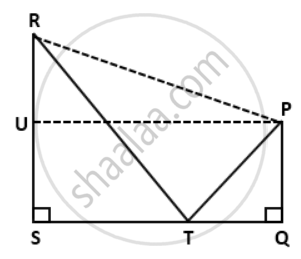
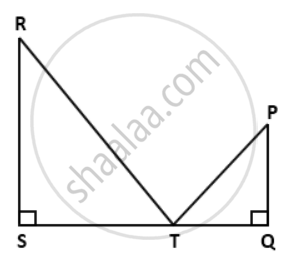
In the given figure, PQ = `"RS"/(3)` = 8cm, 3ST = 4QT = 48cm.
SHow that ∠RTP = 90°.
Advertisements
उत्तर

PQ = `"RS"/(3)` = 8cm
⇒ PQ = 8cm and RS = 3 x 8 = 24cm
3ST = 4QT = 48cm
⇒ ST = `(48)/(3) = 16"cm" and "QT" = (48)/(4)` = 12cm
In ΔPTQ,
PT2 = PQ2 + QT2
= 82 + 122
= 64 + 144
= 208
In ΔRTS,
RT2 = RS2 + ST2
= 242 + 162
= 576 + 256
= 832
Now, PT2 + RT2
= 208 + 832
= 1040 .....(i)
Draw PU ⊥ RS and Join PR.
PU = SQ
= ST + TQ
= 16 + 12
= 28cm
RU = RS - US
= RS - PQ
= 24 - 8
= 16cm
In ΔRUP,
PR2 = RU2 + PU2
= 162 + 282
= 256 + 784
= 1040 ....(ii)
From (i) and (ii), we get
PT2 + RT2 = PR2
Thus, ∠RTP = 90°.
APPEARS IN
संबंधित प्रश्न
In triangle ABC, ∠C=90°. Let BC= a, CA= b, AB= c and let 'p' be the length of the perpendicular from 'C' on AB, prove that:
1. cp = ab
2. `1/p^2=1/a^2+1/b^2`
A ladder 10 m long reaches a window 8 m above the ground. Find the distance of the foot of the ladder from base of the wall.
Tick the correct answer and justify: In ΔABC, AB = `6sqrt3` cm, AC = 12 cm and BC = 6 cm.
The angle B is:
In the given figure, AD is a median of a triangle ABC and AM ⊥ BC. Prove that:

`"AC"^2 = "AD"^2 + "BC"."DM" + (("BC")/2)^2`
Identify, with reason, if the following is a Pythagorean triplet.
(24, 70, 74)
In the figure, given below, AD ⊥ BC.
Prove that: c2 = a2 + b2 - 2ax.
In the following Figure ∠ACB= 90° and CD ⊥ AB, prove that CD2 = BD × AD

Find the side of the square whose diagonal is `16sqrt(2)` cm.
In triangle PQR, angle Q = 90°, find: PR, if PQ = 8 cm and QR = 6 cm
Find the Pythagorean triplet from among the following set of numbers.
4, 5, 6
In an equilateral triangle ABC, the side BC is trisected at D. Prove that 9 AD2 = 7 AB2.
In a triangle ABC, AC > AB, D is the midpoint BC, and AE ⊥ BC. Prove that: AC2 - AB2 = 2BC x ED
In a right-angled triangle ABC,ABC = 90°, AC = 10 cm, BC = 6 cm and BC produced to D such CD = 9 cm. Find the length of AD.
In a square PQRS of side 5 cm, A, B, C and D are points on sides PQ, QR, RS and SP respectively such as PA = PD = RB = RC = 2 cm. Prove that ABCD is a rectangle. Also, find the area and perimeter of the rectangle.
Determine whether the triangle whose lengths of sides are 3 cm, 4 cm, 5 cm is a right-angled triangle.
The perpendicular PS on the base QR of a ∆PQR intersects QR at S, such that QS = 3 SR. Prove that 2PQ2 = 2PR2 + QR2
Find the unknown side in the following triangles
The perimeters of two similar triangles ABC and PQR are 60 cm and 36 cm respectively. If PQ = 9 cm, then AB equals ______.
A flag pole 18 m high casts a shadow 9.6 m long. Find the distance of the top of the pole from the far end of the shadow.
In ∆PQR, PD ⊥ QR such that D lies on QR. If PQ = a, PR = b, QD = c and DR = d, prove that (a + b)(a – b) = (c + d)(c – d).