Advertisements
Advertisements
प्रश्न
The perpendicular PS on the base QR of a ∆PQR intersects QR at S, such that QS = 3 SR. Prove that 2PQ2 = 2PR2 + QR2
Advertisements
उत्तर
Given QS = 3SR
QR = QS + SR
= 3SR + SR = 4SR
SR = `1/4` QR ...(1)
QS = 3SR
SR = `"QS"/3` ...(2)
From (1) and (2) we get
`1/4 "QR" = "QS"/3`
∴ QS = `3/4` QR ...(3)
In the right ∆PQS,
PQ2 = PS2 + QS2 ...(4)
Similarly in ∆PSR
PR2 = PS2 + SR2 ...(5)
Subtract (4) and (5)
PQ2 – PR2 = PS2 + QS2 – PS2 – SR2
= QS2 – SR2
PQ2 – PR2 = `[3/4 "QR"]^2 - ["QR"/4]^2`
From (3) and (1)
= `(9"QR"^2)/16 - "QR"^2/16`
= `(8"QR"^2)/16`
PQ2 – PR2 = `1/2 "QR"^2`
2PQ2 – 2PR2 = QR2
2PQ2 = 2PR2 + QR2
Hence the proved.
APPEARS IN
संबंधित प्रश्न
A tree is broken at a height of 5 m from the ground and its top touches the ground at a distance of 12 m from the base of the tree. Find the original height of the tree.
Find the perimeter of the rectangle whose length is 40 cm and a diagonal is 41 cm.
Prove that the points A(0, −1), B(−2, 3), C(6, 7) and D(8, 3) are the vertices of a rectangle ABCD?
Prove that `(sin θ + cosec θ)^2 + (cos θ + sec θ)^2 = 7 + tan^2 θ + cot^2 θ`.
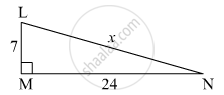
In the figure below, find the value of 'x'.
Find the Pythagorean triplet from among the following set of numbers.
3, 4, 5
A ladder 25m long reaches a window of a building 20m above the ground. Determine the distance of the foot of the ladder from the building.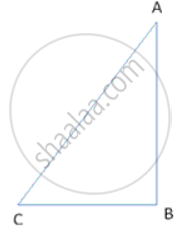
From a point O in the interior of aΔABC, perpendicular OD, OE and OF are drawn to the sides BC, CA and AB respectively. Prove that: AF2 + BD2 + CE2 = AE2 + CD2 + BF2
In figure, PQR is a right triangle right angled at Q and QS ⊥ PR. If PQ = 6 cm and PS = 4 cm, find QS, RS and QR.
Two rectangles are congruent, if they have same ______ and ______.
