Advertisements
Advertisements
प्रश्न
5 m long ladder is placed leaning towards a vertical wall such that it reaches the wall at a point 4 m high. If the foot of the ladder is moved 1.6 m towards the wall, then find the distance by which the top of the ladder would slide upwards on the wall.
Advertisements
उत्तर
“C” is the position of the foot of the ladder “A” is the position of the top of the ladder.
In the right ∆ABC,
BC2 = AC2 – AB2
= 52 – 42
= 25 – 16
= 9
BC = `sqrt(9)` = 3 m
When the foot of the ladder moved 1.6 m toward the wall.
The distance between the foot of the ladder to the ground is
BE = 3 – 1.6 m = 1.4 m
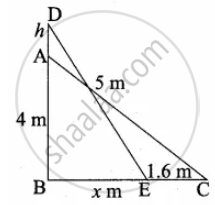
Let the distance moved upward on the wall be “h” m
The ladder touch the wall at (4 + h) M
In the right ∆BED,
ED2 = AB2 + BE2
52 = (4 + h)2 + (1.4)2
25 – 1.96 = (4 + h)2
∴ 4 + h = `sqrt(23.04)`
4 + h = 4.8 m
h = 4.8 – 4
= 0.8 m
Distance moved upward on the wall = 0.8 m
APPEARS IN
संबंधित प्रश्न
Sides of the triangle are 7 cm, 24 cm, and 25 cm. Determine whether the triangle is a right-angled triangle or not.
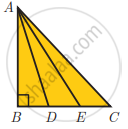
In the adjacent figure, ABC is a right angled triangle with right angle at B and points D, E trisect BC. Prove that 8AE2 = 3AC2 + 5AD2
If in ∆ABC, DE || BC. AB = 3.6 cm, AC = 2.4 cm and AD = 2.1 cm then the length of AE is
In a ∆ABC, AD is the bisector of ∠BAC. If AB = 8 cm, BD = 6 cm and DC = 3 cm. The length of the side AC is
Check whether given sides are the sides of right-angled triangles, using Pythagoras theorem
9, 40, 41
The area of a rectangle of length 21 cm and diagonal 29 cm is __________
If a triangle having sides 8 cm, 15 cm and 17 cm, then state whether given triangle is right angled triangle or not.
In ∆LMN, l = 5, m = 13, n = 12 then complete the activity to show that whether the given triangle is right angled triangle or not.
*(l, m, n are opposite sides of ∠L, ∠M, ∠N respectively)
Activity: In ∆LMN, l = 5, m = 13, n = `square`
∴ l2 = `square`, m2 = 169, n2 = 144.
∴ l2 + n2 = 25 + 144 = `square`
∴ `square` + l2 = m2
∴ By Converse of Pythagoras theorem, ∆LMN is right angled triangle.
In the given figure, triangle PQR is right-angled at Q. S is the mid-point of side QR. Prove that QR2 = 4(PS2 – PQ2).

In a right angled triangle, right-angled at B, lengths of sides AB and AC are 5 cm and 13 cm, respectively. What will be the length of side BC?
