Advertisements
Advertisements
प्रश्न
The perpendicular PS on the base QR of a ∆PQR intersects QR at S, such that QS = 3 SR. Prove that 2PQ2 = 2PR2 + QR2
Advertisements
उत्तर
Given QS = 3SR
QR = QS + SR
= 3SR + SR = 4SR
SR = `1/4` QR ...(1)
QS = 3SR
SR = `"QS"/3` ...(2)
From (1) and (2) we get
`1/4 "QR" = "QS"/3`
∴ QS = `3/4` QR ...(3)
In the right ∆PQS,
PQ2 = PS2 + QS2 ...(4)
Similarly in ∆PSR
PR2 = PS2 + SR2 ...(5)
Subtract (4) and (5)
PQ2 – PR2 = PS2 + QS2 – PS2 – SR2
= QS2 – SR2
PQ2 – PR2 = `[3/4 "QR"]^2 - ["QR"/4]^2`
From (3) and (1)
= `(9"QR"^2)/16 - "QR"^2/16`
= `(8"QR"^2)/16`
PQ2 – PR2 = `1/2 "QR"^2`
2PQ2 – 2PR2 = QR2
2PQ2 = 2PR2 + QR2
Hence the proved.
APPEARS IN
संबंधित प्रश्न
The points A(4, 7), B(p, 3) and C(7, 3) are the vertices of a right traingle ,right-angled at B. Find the values of p.
A guy wire attached to a vertical pole of height 18 m is 24 m long and has a stake attached to the other end. How far from the base of the pole should the stake be driven so that the wire will be taut?
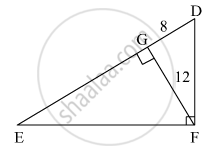
In the given figure, ∠DFE = 90°, FG ⊥ ED, If GD = 8, FG = 12, find (1) EG (2) FD and (3) EF
Two poles of heights 6 m and 11 m stand vertically on a plane ground. If the distance between their feet is 12 m;
find the distance between their tips.
In triangle ABC, AB = AC = x, BC = 10 cm and the area of the triangle is 60 cm2.
Find x.
In triangle ABC, AB = AC and BD is perpendicular to AC.
Prove that: BD2 − CD2 = 2CD × AD
The top of a ladder of length 15 m reaches a window 9 m above the ground. What is the distance between the base of the wall and that of the ladder?
Find the Pythagorean triplet from among the following set of numbers.
4, 7, 8
The sides of the triangle are given below. Find out which one is the right-angled triangle?
8, 15, 17
An isosceles triangle has equal sides each 13 cm and a base 24 cm in length. Find its height
