Advertisements
Advertisements
प्रश्न
A tree is broken at a height of 5 m from the ground and its top touches the ground at a distance of 12 m from the base of the tree. Find the original height of the tree.
Advertisements
उत्तर

In the given figure, BC represents the unbroken part of the tree. Point C represents the point where the tree broke and CA represents the broken part of the tree. Triangle ABC, thus formed, is right-angled at B.
Applying Pythagoras theorem in ΔABC,
AC2 = BC2 + AB2
AC2 = (5 m)2 + (12 m)2
AC2 = 25 m2 + 144 m2
AC2 = 169 m2
AC = 13 m
Thus, original height of the tree = AC + CB
= 13 m + 5 m
= 18 m
संबंधित प्रश्न
Which of the following can be the sides of a right triangle?
2 cm, 2 cm, 5 cm
In the case of right-angled triangles, identify the right angles.
Identify, with reason, if the following is a Pythagorean triplet.
(24, 70, 74)
In ∆ABC, ∠BAC = 90°, seg BL and seg CM are medians of ∆ABC. Then prove that:
4(BL2 + CM2) = 5 BC2

In the following figure, AD is perpendicular to BC and D divides BC in the ratio 1: 3.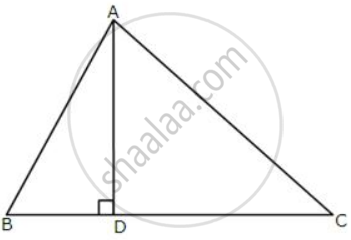
Prove that : 2AC2 = 2AB2 + BC2
In a quadrilateral ABCD, ∠B = 90° and ∠D = 90°.
Prove that: 2AC2 - AB2 = BC2 + CD2 + DA2
The sides of the triangle are given below. Find out which one is the right-angled triangle?
40, 20, 30
PQR is an isosceles triangle with PQ = PR = 10 cm and QR = 12 cm. Find the length of the perpendicular from P to QR.
An isosceles triangle has equal sides each 13 cm and a base 24 cm in length. Find its height
The hypotenuse of a right angled triangle of sides 12 cm and 16 cm is __________
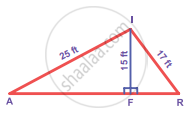
In the figure, find AR