हिंदी

In equilateral Δ ABC, AD ⊥ BC and BC = x cm. Find, in terms of x, the length of AD. - Mathematics

Advertisements
Advertisements

प्रश्न

In equilateral Δ ABC, AD ⊥ BC and BC = x cm. Find, in terms of x, the length of AD.

योग
Advertisements

उत्तर १
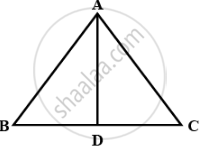
In equilateral Δ ABC, AD ⊥ BC.
Therefore, BC = x cm.

Area of equilateral ΔABC = `sqrt3/4 xx "side"^2  = 1/2 xx "base" xx "height"`

= `sqrt3/4 xx x^2 = 1/2 xx x xx "AD"`

AD = `sqrt3/2 x`

shaalaa.com

उत्तर २

In △ADC and △ADB,

AD = AD    ...(Common)

∠ADB = ∠ADC ...(Each 90°)

AB = AC  ....(Given, ABC is an equilateral triangle)

Thus, △ADC ≅ △ADB

BD = DC = `1/2`​BC ...(By cpct)

Hence, BD = `1/2`​​x

In △ADB,

∠D = 90°

△ADB is right angle triangle,

by Pythagoras theorem,

AB2 = BD2 + AD2

`x^2 = (1/2​x)^2 + "AD"^2`

`"AD"^2 = x^2 − (x^2)/4`

`"AD"^2 = 3/4​x^2`

`"AD" = (sqrt(3))/2x`

shaalaa.com
  क्या इस प्रश्न या उत्तर में कोई त्रुटि है?
अध्याय 13: Pythagoras Theorem [Proof and Simple Applications with Converse] - Exercise 13 (B) [पृष्ठ १६३]

APPEARS IN

सेलिना Concise Mathematics [English] Class 9 ICSE
अध्याय 13 Pythagoras Theorem [Proof and Simple Applications with Converse]
Exercise 13 (B) | Q 2 | पृष्ठ १६३

संबंधित प्रश्न

In figure, ∠B of ∆ABC is an acute angle and AD ⊥ BC, prove that AC2 = AB2 + BC2 – 2BC × BD


In the given figure, ∆ABC is an equilateral triangle of side 3 units. Find the coordinates of the other two vertices ?


Identify, with reason, if the following is a Pythagorean triplet.

(5, 12, 13)


In triangle ABC, angle A = 90o, CA = AB and D is the point on AB produced.
Prove that DC2 - BD2 = 2AB.AD.


Find the side of the square whose diagonal is `16sqrt(2)` cm.


If P and Q are the points on side CA and CB respectively of ΔABC, right angled at C, prove that (AQ2 + BP2 ) = (AB2 + PQ2)


The sides of the triangle are given below. Find out which one is the right-angled triangle?

40, 20, 30


Find the length of the perpendicular of a triangle whose base is 5cm and the hypotenuse is 13cm. Also, find its area.


Calculate the area of a right-angled triangle whose hypotenuse is 65cm and one side is 16cm.


In ΔABC, AD is perpendicular to BC. Prove that: AB2 + CD2 = AC2 + BD2


In an equilateral triangle ABC, the side BC is trisected at D. Prove that 9 AD2 = 7 AB2.


In a triangle ABC, AC > AB, D is the midpoint BC, and AE ⊥ BC. Prove that: AB2 + AC2 = 2AD2 + `(1)/(2)"BC"^2`


In a triangle ABC, AC > AB, D is the midpoint BC, and AE ⊥ BC. Prove that: AB2 + AC2 = 2(AD2 + CD2)


In a right-angled triangle PQR, right-angled at Q, S and T are points on PQ and QR respectively such as PT = SR = 13 cm, QT = 5 cm and PS = TR. Find the length of PQ and PS.


If ‘l‘ and ‘m’ are the legs and ‘n’ is the hypotenuse of a right angled triangle then, l2 = ________


Find the unknown side in the following triangles


In a right angled triangle, if length of hypotenuse is 25 cm and height is 7 cm, then what is the length of its base?


In the given figure, ∠T and ∠B are right angles. If the length of AT, BC and AS (in centimeters) are 15, 16, and 17 respectively, then the length of TC (in centimeters) is ______.


In the adjoining figure, a tangent is drawn to a circle of radius 4 cm and centre C, at the point S. Find the length of the tangent ST, if CT = 10 cm.


The perimeter of the rectangle whose length is 60 cm and a diagonal is 61 cm is ______.


Share
Notifications

Englishहिंदीमराठी


      Forgot password?
Use app×