English

In equilateral Δ ABC, AD ⊥ BC and BC = x cm. Find, in terms of x, the length of AD. - Mathematics

Advertisements
Advertisements

Question

In equilateral Δ ABC, AD ⊥ BC and BC = x cm. Find, in terms of x, the length of AD.

Sum
Advertisements

Solution 1
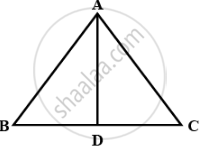
In equilateral Δ ABC, AD ⊥ BC.
Therefore, BC = x cm.

Area of equilateral ΔABC = `sqrt3/4 xx "side"^2  = 1/2 xx "base" xx "height"`

= `sqrt3/4 xx x^2 = 1/2 xx x xx "AD"`

AD = `sqrt3/2 x`

shaalaa.com

Solution 2

In △ADC and △ADB,

AD = AD    ...(Common)

∠ADB = ∠ADC ...(Each 90°)

AB = AC  ....(Given, ABC is an equilateral triangle)

Thus, △ADC ≅ △ADB

BD = DC = `1/2`​BC ...(By cpct)

Hence, BD = `1/2`​​x

In △ADB,

∠D = 90°

△ADB is right angle triangle,

by Pythagoras theorem,

AB2 = BD2 + AD2

`x^2 = (1/2​x)^2 + "AD"^2`

`"AD"^2 = x^2 − (x^2)/4`

`"AD"^2 = 3/4​x^2`

`"AD" = (sqrt(3))/2x`

shaalaa.com
  Is there an error in this question or solution?
Chapter 13: Pythagoras Theorem [Proof and Simple Applications with Converse] - Exercise 13 (B) [Page 163]

APPEARS IN

Selina Concise Mathematics [English] Class 9 ICSE
Chapter 13 Pythagoras Theorem [Proof and Simple Applications with Converse]
Exercise 13 (B) | Q 2 | Page 163

RELATED QUESTIONS

Sides of triangle are given below. Determine it is a right triangle or not? In case of a right triangle, write the length of its hypotenuse. 7 cm, 24 cm, 25 cm


ABC is an isosceles triangle with AC = BC. If AB2 = 2AC2, prove that ABC is a right triangle.


A guy wire attached to a vertical pole of height 18 m is 24 m long and has a stake attached to the other end. How far from the base of the pole should the stake be driven so that the wire will be taut?


Tick the correct answer and justify: In ΔABC, AB = `6sqrt3` cm, AC = 12 cm and BC = 6 cm.

The angle B is:


Choose the correct alternative: 

In right-angled triangle PQR, if hypotenuse PR = 12 and PQ = 6, then what is the measure of ∠P? 


If P and Q are the points on side CA and CB respectively of ΔABC, right angled at C, prove that (AQ2 + BP2 ) = (AB2 + PQ2)


Triangle XYZ is right-angled at vertex Z. Calculate the length of YZ, if XY = 13 cm and XZ = 12 cm.


Find the Pythagorean triplet from among the following set of numbers.

4, 7, 8


The sides of the triangle are given below. Find out which one is the right-angled triangle?

1.5, 1.6, 1.7


A point OI in the interior of a rectangle ABCD is joined with each of the vertices A, B, C and D. Prove that  OB2 + OD2 = OC2 + OA2


In a triangle ABC right angled at C, P and Q are points of sides CA and CB respectively, which divide these sides the ratio 2 : 1.
Prove that : 9(AQ2 + BP2) = 13AB2 


The perpendicular PS on the base QR of a ∆PQR intersects QR at S, such that QS = 3 SR. Prove that 2PQ2 = 2PR2 + QR2 


Find the unknown side in the following triangles


An isosceles triangle has equal sides each 13 cm and a base 24 cm in length. Find its height


In the figure, find AR


Prove that the area of the equilateral triangle drawn on the hypotenuse of a right angled triangle is equal to the sum of the areas of the equilateral triangles drawn on the other two sides of the triangle.


The longest side of a right angled triangle is called its ______.


If two legs of a right triangle are equal to two legs of another right triangle, then the right triangles are congruent.


Height of a pole is 8 m. Find the length of rope tied with its top from a point on the ground at a distance of 6 m from its bottom.


Share
Notifications

Englishहिंदीमराठी


      Forgot password?
Use app×