मराठी

In equilateral Δ ABC, AD ⊥ BC and BC = x cm. Find, in terms of x, the length of AD.

Advertisements
Advertisements

प्रश्न

In equilateral Δ ABC, AD ⊥ BC and BC = x cm. Find, in terms of x, the length of AD.

बेरीज
Advertisements

उत्तर १
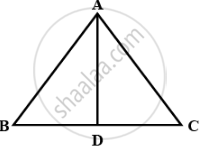
In equilateral Δ ABC, AD ⊥ BC.
Therefore, BC = x cm.

Area of equilateral ΔABC = `sqrt3/4 xx "side"^2  = 1/2 xx "base" xx "height"`

= `sqrt3/4 xx x^2 = 1/2 xx x xx "AD"`

AD = `sqrt3/2 x`

shaalaa.com

उत्तर २

In △ADC and △ADB,

AD = AD    ...(Common)

∠ADB = ∠ADC ...(Each 90°)

AB = AC  ....(Given, ABC is an equilateral triangle)

Thus, △ADC ≅ △ADB

BD = DC = `1/2`​BC ...(By cpct)

Hence, BD = `1/2`​​x

In △ADB,

∠D = 90°

△ADB is right angle triangle,

by Pythagoras theorem,

AB2 = BD2 + AD2

`x^2 = (1/2​x)^2 + "AD"^2`

`"AD"^2 = x^2 − (x^2)/4`

`"AD"^2 = 3/4​x^2`

`"AD" = (sqrt(3))/2x`

shaalaa.com
  या प्रश्नात किंवा उत्तरात काही त्रुटी आहे का?
पाठ 13: Pythagoras Theorem [Proof and Simple Applications with Converse] - Exercise 13 (B) [पृष्ठ १६३]

APPEARS IN

सेलिना Concise Mathematics [English] Class 9 ICSE
पाठ 13 Pythagoras Theorem [Proof and Simple Applications with Converse]
Exercise 13 (B) | Q 2 | पृष्ठ १६३

संबंधित प्रश्‍न

The diagonal of a rectangular field is 16 metres more than the shorter side. If the longer side is 14 metres more than the shorter side, then find the lengths of the sides of the field.


Side of a triangle is given, determine it is a right triangle.

`(2a – 1) cm, 2\sqrt { 2a } cm, and (2a + 1) cm`


A man goes 10 m due east and then 24 m due north. Find the distance from the starting point


D and E are points on the sides CA and CB respectively of a triangle ABC right angled at C. Prove that AE+ BD2 = AB2 + DE2


Find the perimeter of the rectangle whose length is 40 cm and a diagonal is 41 cm.


Identify, with reason, if the following is a Pythagorean triplet.

(5, 12, 13)


Identify, with reason, if the following is a Pythagorean triplet.
(10, 24, 27)


In ∆PQR, point S is the midpoint of side QR. If PQ = 11, PR = 17, PS = 13, find QR.


In a trapezium ABCD, seg AB || seg DC seg BD ⊥ seg AD, seg AC ⊥ seg BC, If AD = 15, BC = 15 and AB = 25. Find A(▢ABCD)


A man goes 40 m due north and then 50 m due west. Find his distance from the starting point.


In triangle ABC, AB = AC = x, BC = 10 cm and the area of the triangle is 60 cm2.
Find x.


Find the value of (sin2 33 + sin2 57°)


Prove that in a right angle triangle, the square of the hypotenuse is equal to the sum of squares of the other two sides.


In the given figure, BL and CM are medians of a ∆ABC right-angled at A. Prove that 4 (BL2 + CM2) = 5 BC2.


The sides of a certain triangle is given below. Find, which of them is right-triangle

6 m, 9 m, and 13 m


A boy first goes 5 m due north and then 12 m due east. Find the distance between the initial and the final position of the boy.


Two poles of height 9m and 14m stand on a plane ground. If the distance between their 12m, find the distance between their tops.


If ‘l‘ and ‘m’ are the legs and ‘n’ is the hypotenuse of a right angled triangle then, l2 = ________


Sides AB and BE of a right triangle, right-angled at B are of lengths 16 cm and 8 cm respectively. The length of the side of largest square FDGB that can be inscribed in the triangle ABE is ______.


Jiya walks 6 km due east and then 8 km due north. How far is she from her starting place?


Share
Notifications

Englishहिंदीमराठी


      Forgot password?
Use app×