Advertisements
Advertisements
प्रश्न
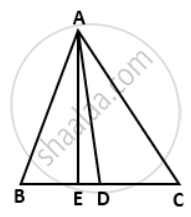
In a triangle ABC, AC > AB, D is the midpoint BC, and AE ⊥ BC. Prove that: AB2 + AC2 = 2(AD2 + CD2)
Advertisements
उत्तर

We have ∠AED = 90°
∴ ∠ADE < 90° and ∠ADC > 90°
i.e. ∠ADE is acute and ∠ADC is obtuse.
From (iii), we have
AB2 + AC2 = `2"AD"^2 + (1)/(2)"BC"^2`
⇒ AB2 + AC2 = `2"AD"^2 + (1)/(2)(2 xx "CD")^2`
⇒ AB2 + AC2 = `2"AD"^2 + (1)/(2) xx 4"CD"^2`
⇒ AB2 + AC2 = 2AD2 + 2CD2
⇒ AB2 + AC2 = 2(AD2 + CD2).
APPEARS IN
संबंधित प्रश्न
ABCD is a rhombus. Prove that AB2 + BC2 + CD2 + DA2= AC2 + BD2
In Figure, ABD is a triangle right angled at A and AC ⊥ BD. Show that AD2 = BD × CD

A guy wire attached to a vertical pole of height 18 m is 24 m long and has a stake attached to the other end. How far from the base of the pole should the stake be driven so that the wire will be taut?
The perpendicular from A on side BC of a Δ ABC intersects BC at D such that DB = 3CD . Prove that 2AB2 = 2AC2 + BC2.

In the given figure, ABC is a triangle in which ∠ABC> 90° and AD ⊥ CB produced. Prove that AC2 = AB2 + BC2 + 2BC.BD.

Identify, with reason, if the following is a Pythagorean triplet.
(3, 5, 4)
Identify, with reason, if the following is a Pythagorean triplet.
(5, 12, 13)
In the figure: ∠PSQ = 90o, PQ = 10 cm, QS = 6 cm and RQ = 9 cm. Calculate the length of PR.
The given figure shows a quadrilateral ABCD in which AD = 13 cm, DC = 12 cm, BC = 3 cm and ∠ABD = ∠BCD = 90o. Calculate the length of AB.
AD is drawn perpendicular to base BC of an equilateral triangle ABC. Given BC = 10 cm, find the length of AD, correct to 1 place of decimal.
ABC is a triangle, right-angled at B. M is a point on BC.
Prove that: AM2 + BC2 = AC2 + BM2
In the figure below, find the value of 'x'.

The top of a ladder of length 15 m reaches a window 9 m above the ground. What is the distance between the base of the wall and that of the ladder?
Find the Pythagorean triplet from among the following set of numbers.
3, 4, 5
Each side of rhombus is 10cm. If one of its diagonals is 16cm, find the length of the other diagonals.
In a triangle ABC, AC > AB, D is the midpoint BC, and AE ⊥ BC. Prove that: AB2 = AD2 - BC x CE + `(1)/(4)"BC"^2`
To get from point A to point B you must avoid walking through a pond. You must walk 34 m south and 41 m east. To the nearest meter, how many meters would be saved if it were possible to make a way through the pond?
The hypotenuse of a right angled triangle of sides 12 cm and 16 cm is __________
In the figure, find AR
In a right angled triangle, if length of hypotenuse is 25 cm and height is 7 cm, then what is the length of its base?