Advertisements
Advertisements
प्रश्न
The sides of the triangle are given below. Find out which one is the right-angled triangle?
40, 20, 30
Advertisements
उत्तर
It is known that, if in a triplet of natural numbers, the square of the biggest number is equal to the sum of the squares of the other two numbers, then the three numbers form a Pythagorean triplet. If the lengths of the sides of a triangle form such a triplet, then the triangle is a right-angled triangle.
The sides of the given triangle are 40, 20, and 30.
Let us check whether the given set (40, 20, 30) forms a Pythagorean triplet or not.
The biggest number among the given set is 40.
(40)2 = 1600; (20)2 = 400; (30)2 = 900
Now, 400 + 900 = 1300 ≠ 1600
∴ (20)2 + (30)2 ≠ (40)2
Thus, (40, 20, 30) does not form a Pythagorean triplet.
Hence, the given triangle with sides 40, 20, and 30 is not a right-angled triangle.
संबंधित प्रश्न
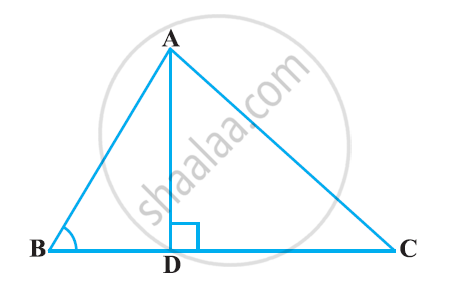
In the given figure, ABC is a triangle in which ∠ABC < 90° and AD ⊥ BC. Prove that AC2 = AB2 + BC2 − 2BC.BD.
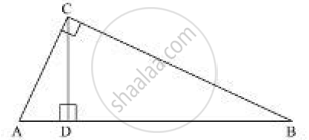
In the following Figure ∠ACB= 90° and CD ⊥ AB, prove that CD2 = BD × AD
Find the length of diagonal of the square whose side is 8 cm.
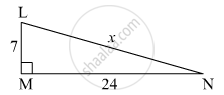
In the figure below, find the value of 'x'.
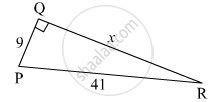
In the figure below, find the value of 'x'.
The foot of a ladder is 6m away from a wall and its top reaches a window 8m above the ground. If the ladder is shifted in such a way that its foot is 8m away from the wall to what height does its tip reach?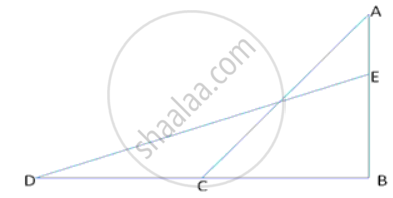
Each side of rhombus is 10cm. If one of its diagonals is 16cm, find the length of the other diagonals.
In a triangle ABC right angled at C, P and Q are points of sides CA and CB respectively, which divide these sides the ratio 2 : 1.
Prove that : 9(AQ2 + BP2) = 13AB2
To get from point A to point B you must avoid walking through a pond. You must walk 34 m south and 41 m east. To the nearest meter, how many meters would be saved if it were possible to make a way through the pond?
Is the triangle with sides 25 cm, 5 cm and 24 cm a right triangle? Give reasons for your answer.
