हिंदी

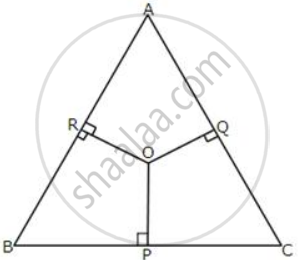
In the following figure, OP, OQ, and OR are drawn perpendiculars to the sides BC, CA and AB respectively of triangle ABC. Prove that: AR2 + BP2 + CQ2 = AQ2 + CP2 + BR2 - Mathematics
Advertisements
Advertisements

प्रश्न

In the following figure, OP, OQ, and OR are drawn perpendiculars to the sides BC, CA and AB respectively of triangle ABC.

Prove that: AR2 + BP2 + CQ2 = AQ2 + CP2 + BR2


योग
Advertisements

उत्तर

Here, we first need to join OA, OB, and OC after which the figure becomes as follows,
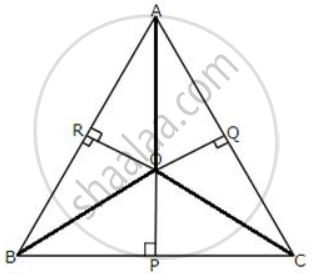
Pythagoras theorem states that in a right-angled triangle, the square on the hypotenuse is equal to the sum of the squares on the remaining two sides. First, we consider the ΔARO and applying Pythagoras theorem we get,

AQ2 = AR2 + OR2

AR2 = AQ2 - OR2            ...(i)

Similarly, from triangles, BPO, COQ, AOQ, CPO, and BRO we get the following results,

BP2 = BO2 - OP2          ...(ii)

CQ2 = OC2 - OQ2        ...(iii)

AQ2 = AO2 - OQ2        ...(iv)

CP2 = OC2 - OP2          ...(v)

BR2 = OB2 - OR2          ...(vi)

Adding (i), (ii) and (iii), we get 

AR2 + BP2 + CQ2 = AQ2 - OR2 + BO2 - OP2 + OC2 - OQ2    ...(vii)

Adding (iv), (v) and (vi), we get,

AQ2 + CP2 + BR2 = AO2 - OR2 + BO2 - OP2 + OC2 - OQ2     ...(viii)

From (vii) and (viii), we get,

AR2 + BP2 + CQ2 = AQ2 + CP2 + BR2

Hence, proved.

shaalaa.com
  क्या इस प्रश्न या उत्तर में कोई त्रुटि है?
अध्याय 13: Pythagoras Theorem [Proof and Simple Applications with Converse] - Exercise 13 (B) [पृष्ठ १६४]

APPEARS IN

सेलिना Concise Mathematics [English] Class 9 ICSE
अध्याय 13 Pythagoras Theorem [Proof and Simple Applications with Converse]
Exercise 13 (B) | Q 9 | पृष्ठ १६४

संबंधित प्रश्न

Sides of triangle are given below. Determine it is a right triangle or not? In case of a right triangle, write the length of its hypotenuse. 7 cm, 24 cm, 25 cm


Two poles of heights 6 m and 11 m stand on a plane ground. If the distance between the feet of the poles is 12 m, find the distance between their tops.


PQR is a triangle right angled at P. If PQ = 10 cm and PR = 24 cm, find QR.


ABC is a triangle right angled at C. If AB = 25 cm and AC = 7 cm, find BC.


A 15 m long ladder reached a window 12 m high from the ground on placing it against a wall at a distance a. Find the distance of the foot of the ladder from the wall.


Identify, with reason, if the following is a Pythagorean triplet.

(5, 12, 13)


For finding AB and BC with the help of information given in the figure, complete following activity.

AB = BC ..........

∴ ∠BAC =

∴ AB = BC = × AC

                 = × `sqrt8`

                 = × `2sqrt2`

                 =


In the given figure, M is the midpoint of QR. ∠PRQ = 90°. Prove that, PQ= 4PM– 3PR2.


In the figure: ∠PSQ = 90o, PQ = 10 cm, QS = 6 cm and RQ = 9 cm. Calculate the length of PR.


In triangle ABC, AB = AC = x, BC = 10 cm and the area of the triangle is 60 cm2.
Find x.


ABC is a triangle, right-angled at B. M is a point on BC.

Prove that: AM2 + BC2 = AC2 + BM2


O is any point inside a rectangle ABCD.
Prove that: OB2 + OD2 = OC2 + OA2.


Prove that `(sin θ + cosec θ)^2 + (cos θ + sec θ)^2 = 7 + tan^2 θ + cot^2 θ`.


In triangle PQR, angle Q = 90°, find: PQ, if PR = 34 cm and QR = 30 cm


Find the Pythagorean triplet from among the following set of numbers.

2, 4, 5


In an equilateral triangle ABC, the side BC is trisected at D. Prove that 9 AD2 = 7 AB2.


In an isosceles triangle PQR, the length of equal sides PQ and PR is 13 cm and base QR is 10 cm. Find the length of perpendicular bisector drawn from vertex P to side QR.


In an equilateral triangle PQR, prove that PS2 = 3(QS)2.


Two rectangles are congruent, if they have same ______ and ______.


Two poles of 10 m and 15 m stand upright on a plane ground. If the distance between the tops is 13 m, find the distance between their feet.


Share
Notifications

Englishहिंदीमराठी


      Forgot password?
Use app×