मराठी

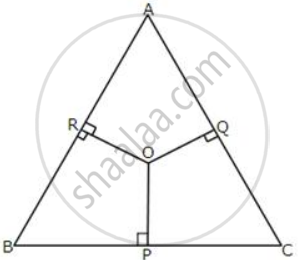
In the following figure, OP, OQ, and OR are drawn perpendiculars to the sides BC, CA and AB respectively of triangle ABC. Prove that: AR2 + BP2 + CQ2 = AQ2 + CP2 + BR2 - Mathematics
Advertisements
Advertisements

प्रश्न

In the following figure, OP, OQ, and OR are drawn perpendiculars to the sides BC, CA and AB respectively of triangle ABC.

Prove that: AR2 + BP2 + CQ2 = AQ2 + CP2 + BR2


बेरीज
Advertisements

उत्तर

Here, we first need to join OA, OB, and OC after which the figure becomes as follows,
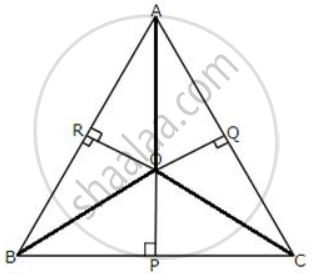
Pythagoras theorem states that in a right-angled triangle, the square on the hypotenuse is equal to the sum of the squares on the remaining two sides. First, we consider the ΔARO and applying Pythagoras theorem we get,

AQ2 = AR2 + OR2

AR2 = AQ2 - OR2            ...(i)

Similarly, from triangles, BPO, COQ, AOQ, CPO, and BRO we get the following results,

BP2 = BO2 - OP2          ...(ii)

CQ2 = OC2 - OQ2        ...(iii)

AQ2 = AO2 - OQ2        ...(iv)

CP2 = OC2 - OP2          ...(v)

BR2 = OB2 - OR2          ...(vi)

Adding (i), (ii) and (iii), we get 

AR2 + BP2 + CQ2 = AQ2 - OR2 + BO2 - OP2 + OC2 - OQ2    ...(vii)

Adding (iv), (v) and (vi), we get,

AQ2 + CP2 + BR2 = AO2 - OR2 + BO2 - OP2 + OC2 - OQ2     ...(viii)

From (vii) and (viii), we get,

AR2 + BP2 + CQ2 = AQ2 + CP2 + BR2

Hence, proved.

shaalaa.com
  या प्रश्नात किंवा उत्तरात काही त्रुटी आहे का?
पाठ 13: Pythagoras Theorem [Proof and Simple Applications with Converse] - Exercise 13 (B) [पृष्ठ १६४]

APPEARS IN

सेलिना Concise Mathematics [English] Class 9 ICSE
पाठ 13 Pythagoras Theorem [Proof and Simple Applications with Converse]
Exercise 13 (B) | Q 9 | पृष्ठ १६४

संबंधित प्रश्‍न

In triangle ABC, ∠C=90°. Let BC= a, CA= b, AB= c and let 'p' be the length of the perpendicular from 'C' on AB, prove that:

1. cp = ab

2. `1/p^2=1/a^2+1/b^2`


The points A(4, 7), B(p, 3) and C(7, 3) are the vertices of a  right traingle ,right-angled at B. Find the values of p.


Prove that the sum of the squares of the diagonals of parallelogram is equal to the sum of the squares of its sides.


The diagonals of a rhombus measure 16 cm and 30 cm. Find its perimeter.


Prove that the points A(0, −1), B(−2, 3), C(6, 7) and D(8, 3) are the vertices of a rectangle ABCD?


In the given figure, M is the midpoint of QR. ∠PRQ = 90°. Prove that, PQ= 4PM– 3PR2.


In ∆ABC, ∠BAC = 90°, seg BL and seg CM are medians of ∆ABC. Then prove that:
4(BL+ CM2) = 5 BC2


Find the side of the square whose diagonal is `16sqrt(2)` cm.


Find the value of (sin2 33 + sin2 57°)


Prove that (1 + cot A - cosec A ) (1 + tan A + sec A) = 2


Find the Pythagorean triplet from among the following set of numbers.

2, 6, 7


The foot of a ladder is 6m away from a wall and its top reaches a window 8m above the ground. If the ladder is shifted in such a way that its foot is 8m away from the wall to what height does its tip reach?


AD is perpendicular to the side BC of an equilateral ΔABC. Prove that 4AD2 = 3AB2.


In a triangle ABC right angled at C, P and Q are points of sides CA and CB respectively, which divide these sides the ratio 2 : 1.
Prove that: 9AQ2 = 9AC2 + 4BC2 


The hypotenuse of a right angled triangle of sides 12 cm and 16 cm is __________


Find the length of the support cable required to support the tower with the floor


From the given figure, in ∆ABQ, if AQ = 8 cm, then AB =?


In an equilateral triangle PQR, prove that PS2 = 3(QS)2.


Two poles of 10 m and 15 m stand upright on a plane ground. If the distance between the tops is 13 m, find the distance between their feet.


The foot of a ladder is 6 m away from its wall and its top reaches a window 8 m above the ground. Find the length of the ladder.


Share
Notifications

Englishहिंदीमराठी


      Forgot password?
Use app×