Advertisements
Advertisements
प्रश्न
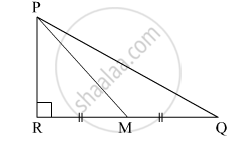
In the given figure, M is the midpoint of QR. ∠PRQ = 90°. Prove that, PQ2 = 4PM2 – 3PR2.
Advertisements
उत्तर
Given: M is the midpoint of QR. ∠PRQ = 90°.
To prove: PQ2 = 4PM2 – 3PR2
Proof:
In ∆PRM,
∠PRM = 90° ...(Given)
By Pythagoras theorem,
∴ PM2 = PR2 + RM2
∴ RM2 = PM2 − PR2 ...(1)
In ∆PRQ,
∠PRQ = 90° ...(Given)
By Pythagoras theorem,
∴ PQ2 = PR2 + RQ2
∴ PQ2 = PR2 + (RM + MQ)2 ...[M is the midpoint of QR]
∴ PQ2 = PR2 + (RM + RM)2
∴ PQ2 = PR2 + (2RM)2
∴ PQ2 = PR2 + 4RM2
∴ PQ2 = PR2 + 4(PM2 − PR2) ...(from 1)
∴ PQ2 = PR2 + 4PM2 − 4PR2
∴ PQ2 = 4PM2 − 3PR2
Hence, PQ2 = 4PM2 – 3PR2.
संबंधित प्रश्न
If the sides of a triangle are 6 cm, 8 cm and 10 cm, respectively, then determine whether the triangle is a right angle triangle or not.
In triangle ABC, ∠C=90°. Let BC= a, CA= b, AB= c and let 'p' be the length of the perpendicular from 'C' on AB, prove that:
1. cp = ab
2. `1/p^2=1/a^2+1/b^2`
The points A(4, 7), B(p, 3) and C(7, 3) are the vertices of a right traingle ,right-angled at B. Find the values of p.
P and Q are the mid-points of the sides CA and CB respectively of a ∆ABC, right angled at C. Prove that:
`(i) 4AQ^2 = 4AC^2 + BC^2`
`(ii) 4BP^2 = 4BC^2 + AC^2`
`(iii) (4AQ^2 + BP^2 ) = 5AB^2`
Prove that the sum of the squares of the diagonals of parallelogram is equal to the sum of the squares of its sides.
In ∆ABC, seg AD ⊥ seg BC, DB = 3CD.
Prove that: 2AB2 = 2AC2 + BC2

In right angle ΔABC, if ∠B = 90°, AB = 6, BC = 8, then find AC.
In triangle ABC, AB = AC and BD is perpendicular to AC.
Prove that: BD2 − CD2 = 2CD × AD
M andN are the mid-points of the sides QR and PQ respectively of a PQR, right-angled at Q.
Prove that:
(i) PM2 + RN2 = 5 MN2
(ii) 4 PM2 = 4 PQ2 + QR2
(iii) 4 RN2 = PQ2 + 4 QR2(iv) 4 (PM2 + RN2) = 5 PR2
In the following Figure ∠ACB= 90° and CD ⊥ AB, prove that CD2 = BD × AD

From the given figure, find the length of hypotenuse AC and the perimeter of ∆ABC.
The length of the diagonals of rhombus are 24cm and 10cm. Find each side of the rhombus.
In a triangle ABC, AC > AB, D is the midpoint BC, and AE ⊥ BC. Prove that: AC2 - AB2 = 2BC x ED
AD is perpendicular to the side BC of an equilateral ΔABC. Prove that 4AD2 = 3AB2.
The perimeters of two similar triangles ABC and PQR are 60 cm and 36 cm respectively. If PQ = 9 cm, then AB equals ______.
Foot of a 10 m long ladder leaning against a vertical wall is 6 m away from the base of the wall. Find the height of the point on the wall where the top of the ladder reaches.
A 5 m long ladder is placed leaning towards a vertical wall such that it reaches the wall at a point 4 m high. If the foot of the ladder is moved 1.6 m towards the wall, then find the distance by which the top of the ladder would slide upwards on the wall.
Prove that the area of the semicircle drawn on the hypotenuse of a right angled triangle is equal to the sum of the areas of the semicircles drawn on the other two sides of the triangle.
The top of a broken tree touches the ground at a distance of 12 m from its base. If the tree is broken at a height of 5 m from the ground then the actual height of the tree is ______.
If the hypotenuse of one right triangle is equal to the hypotenuse of another right triangle, then the triangles are congruent.
