English
Maharashtra State BoardSSC (English Medium) 10th Standard

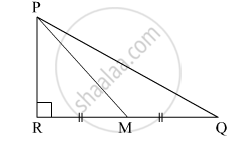
In the given figure, M is the midpoint of QR. ∠PRQ = 90°. Prove that, PQ2 = 4PM2 – 3PR2 - Geometry Mathematics 2

Advertisements
Advertisements

Question

In the given figure, M is the midpoint of QR. ∠PRQ = 90°. Prove that, PQ= 4PM– 3PR2.

Sum
Advertisements

Solution

Given: M is the midpoint of QR. ∠PRQ = 90°.

To prove: PQ= 4PM– 3PR2

Proof: 

In ∆PRM,
∠PRM = 90°                        ...(Given)
By Pythagoras theorem,
∴ PM2 = PR2 + RM2
∴ RM2 = PM2 − PR2             ...(1)

In ∆PRQ,
∠PRQ = 90°                       ...(Given)
By Pythagoras theorem,
∴ PQ2 = PR2 + RQ2
∴ PQ2 = PR2 + (RM + MQ)2        ...[M is the midpoint of QR]
∴ PQ2 = PR2 + (RM + RM)2
∴ PQ2 = PR2 + (2RM)2
∴ PQ2 = PR2 + 4RM2
∴ PQ2 = PR2 + 4(PM2 − PR2)             ...(from 1)
∴ PQ2 = PR2 + 4PM2 − 4PR2
∴ PQ2 = 4PM2 − 3PR2

Hence, PQ= 4PM– 3PR2.

shaalaa.com
  Is there an error in this question or solution?
Chapter 2: Pythagoras Theorem - Practice Set 2.1 [Page 39]

APPEARS IN

Balbharati Mathematics 2 [English] Standard 10 Maharashtra State Board
Chapter 2 Pythagoras Theorem
Practice Set 2.1 | Q 9 | Page 39

Video TutorialsVIEW ALL [1]

RELATED QUESTIONS

Prove that the diagonals of a rectangle ABCD, with vertices A(2, -1), B(5, -1), C(5, 6) and D(2, 6), are equal and bisect each other.


A ladder leaning against a wall makes an angle of 60° with the horizontal. If the foot of the ladder is 2.5 m away from the wall, find the length of the ladder


In Fig., ∆ABC is an obtuse triangle, obtuse angled at B. If AD ⊥ CB, prove that AC2 = AB2 + BC2 + 2BC × BD


In a ∆ABC, AD ⊥ BC and AD2 = BC × CD. Prove ∆ABC is a right triangle


In the following figure, O is a point in the interior of a triangle ABC, OD ⊥ BC, OE ⊥ AC and OF ⊥ AB. Show that

(i) OA2 + OB2 + OC2 − OD2 − OE2 − OF2 = AF2 + BD2 + CE2

(ii) AF2 + BD2 + CE= AE2 + CD2 + BF2


D and E are points on the sides CA and CB respectively of a triangle ABC right angled at C. Prove that AE+ BD2 = AB2 + DE2


In the given figure, ABC is a triangle in which ∠ABC < 90° and AD ⊥ BC. Prove that AC2 = AB2 + BC2 − 2BC.BD.


Which of the following can be the sides of a right triangle?

2 cm, 2 cm, 5 cm

In the case of right-angled triangles, identify the right angles.


In ∆PQR, point S is the midpoint of side QR. If PQ = 11, PR = 17, PS = 13, find QR.


In the figure: ∠PSQ = 90o, PQ = 10 cm, QS = 6 cm and RQ = 9 cm. Calculate the length of PR.


ABC is a triangle, right-angled at B. M is a point on BC.

Prove that: AM2 + BC2 = AC2 + BM2


M andN are the mid-points of the sides QR and PQ respectively of a PQR, right-angled at Q.
Prove that:
(i) PM2 + RN2 = 5 MN2
(ii) 4 PM2 = 4 PQ2 + QR2
(iii) 4 RN2 = PQ2 + 4 QR2(iv) 4 (PM2 + RN2) = 5 PR2


If P and Q are the points on side CA and CB respectively of ΔABC, right angled at C, prove that (AQ2 + BP2) = (AB2 + PQ2)


Choose the correct alternative: 

In right-angled triangle PQR, if hypotenuse PR = 12 and PQ = 6, then what is the measure of ∠P? 


Find the value of (sin2 33 + sin2 57°)


The sides of the triangle are given below. Find out which one is the right-angled triangle?

11, 12, 15


Calculate the area of a right-angled triangle whose hypotenuse is 65cm and one side is 16cm.


AD is perpendicular to the side BC of an equilateral ΔABC. Prove that 4AD2 = 3AB2.


The perpendicular PS on the base QR of a ∆PQR intersects QR at S, such that QS = 3 SR. Prove that 2PQ2 = 2PR2 + QR2 


Share
Notifications

Englishहिंदीमराठी


      Forgot password?
Use app×