Advertisements
Advertisements
Question
The sides of the triangle are given below. Find out which one is the right-angled triangle?
11, 12, 15
Advertisements
Solution
It is known that, if in a triplet of natural numbers, the square of the biggest number is equal to the sum of the squares of the other two numbers, then the three numbers form a Pythagorean triplet. If the lengths of the sides of a triangle form such a triplet, then the triangle is a right-angled triangle.
The sides of the given triangle are 11, 12, and 15.
Let us check whether the given set (11, 12, 15) forms a Pythagorean triplet or not.
The biggest number among the given set is 15.
(15)2 = 225; (11)2 = 121; (12)2 = 144
Now, 121 + 144 = 265 ≠ 225
∴ (11)2 + (12)2 ≠ (15)2
Thus, (11, 12, 15) does not form a Pythagorean triplet.
Hence, the given triangle with sides 8, 15, and 17 is not a right-angled triangle.
RELATED QUESTIONS
In a right triangle ABC right-angled at C, P and Q are the points on the sides CA and CB respectively, which divide these sides in the ratio 2 : 1. Prove that
`(i) 9 AQ^2 = 9 AC^2 + 4 BC^2`
`(ii) 9 BP^2 = 9 BC^2 + 4 AC^2`
`(iii) 9 (AQ^2 + BP^2 ) = 13 AB^2`
ABC is an isosceles triangle right angled at C. Prove that AB2 = 2AC2
A 15 m long ladder reached a window 12 m high from the ground on placing it against a wall at a distance a. Find the distance of the foot of the ladder from the wall.
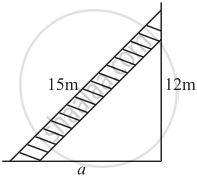
A man goes 40 m due north and then 50 m due west. Find his distance from the starting point.
In the given figure, ∠B = 90°, XY || BC, AB = 12 cm, AY = 8cm and AX : XB = 1 : 2 = AY : YC.
Find the lengths of AC and BC.

AD is drawn perpendicular to base BC of an equilateral triangle ABC. Given BC = 10 cm, find the length of AD, correct to 1 place of decimal.
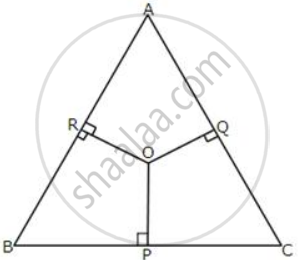
In the following figure, OP, OQ, and OR are drawn perpendiculars to the sides BC, CA and AB respectively of triangle ABC.
Prove that: AR2 + BP2 + CQ2 = AQ2 + CP2 + BR2
Find the Pythagorean triplet from among the following set of numbers.
4, 7, 8
In triangle ABC, line I, is a perpendicular bisector of BC.
If BC = 12 cm, SM = 8 cm, find CS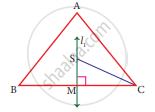
Height of a pole is 8 m. Find the length of rope tied with its top from a point on the ground at a distance of 6 m from its bottom.
