Advertisements
Advertisements
Question
The sides of the triangle are given below. Find out which one is the right-angled triangle?
8, 15, 17
Advertisements
Solution
It is known that, if in a triplet of natural numbers, the square of the biggest number is equal to the sum of the squares of the other two numbers, then the three numbers form a Pythagorean triplet. If the lengths of the sides of a triangle form such a triplet, then the triangle is a right-angled triangle.
The sides of the given triangle are 8, 15, and 17.
Let us check whether the given set (8, 15, 17) forms a Pythagorean triplet or not.
The biggest number among the given set is 17.
(17)2 = 289; (15)2 = 225; (8)2 = 64
Now, 225 + 64 = 289
∴ (15)2 + (8)2 = (17)2
Thus, (8, 15, 17) forms a Pythagorean triplet.
Hence, the given triangle with sides 8, 15, and 17 is a right-angled triangle.
RELATED QUESTIONS
PQR is a triangle right angled at P and M is a point on QR such that PM ⊥ QR. Show that PM2 = QM . MR
In the given figure, AD is a median of a triangle ABC and AM ⊥ BC. Prove that:
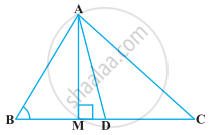
`"AC"^2 = "AD"^2 + "BC"."DM" + (("BC")/2)^2`
Identify, with reason, if the following is a Pythagorean triplet.
(3, 5, 4)
Diagonals of rhombus ABCD intersect each other at point O.
Prove that: OA2 + OC2 = 2AD2 - `"BD"^2/2`
M andN are the mid-points of the sides QR and PQ respectively of a PQR, right-angled at Q.
Prove that:
(i) PM2 + RN2 = 5 MN2
(ii) 4 PM2 = 4 PQ2 + QR2
(iii) 4 RN2 = PQ2 + 4 QR2(iv) 4 (PM2 + RN2) = 5 PR2
Find the Pythagorean triplet from among the following set of numbers.
2, 4, 5
∆ABC is right-angled at C. If AC = 5 cm and BC = 12 cm. find the length of AB.
The hypotenuse of a right angled triangle of sides 12 cm and 16 cm is __________
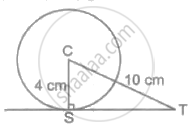
In the adjoining figure, a tangent is drawn to a circle of radius 4 cm and centre C, at the point S. Find the length of the tangent ST, if CT = 10 cm.
The foot of a ladder is 6 m away from its wall and its top reaches a window 8 m above the ground. If the ladder is shifted in such a way that its foot is 8 m away from the wall, to what height does its top reach?
