Advertisements
Advertisements
प्रश्न
The sides of the triangle are given below. Find out which one is the right-angled triangle?
11, 12, 15
Advertisements
उत्तर
It is known that, if in a triplet of natural numbers, the square of the biggest number is equal to the sum of the squares of the other two numbers, then the three numbers form a Pythagorean triplet. If the lengths of the sides of a triangle form such a triplet, then the triangle is a right-angled triangle.
The sides of the given triangle are 11, 12, and 15.
Let us check whether the given set (11, 12, 15) forms a Pythagorean triplet or not.
The biggest number among the given set is 15.
(15)2 = 225; (11)2 = 121; (12)2 = 144
Now, 121 + 144 = 265 ≠ 225
∴ (11)2 + (12)2 ≠ (15)2
Thus, (11, 12, 15) does not form a Pythagorean triplet.
Hence, the given triangle with sides 8, 15, and 17 is not a right-angled triangle.
संबंधित प्रश्न
ABC is a triangle right angled at C. If AB = 25 cm and AC = 7 cm, find BC.
A tree is broken at a height of 5 m from the ground and its top touches the ground at a distance of 12 m from the base of the tree. Find the original height of the tree.
In triangle ABC, AB = AC and BD is perpendicular to AC.
Prove that: BD2 − CD2 = 2CD × AD
In the figure, given below, AD ⊥ BC.
Prove that: c2 = a2 + b2 - 2ax.
In a rectangle ABCD,
prove that: AC2 + BD2 = AB2 + BC2 + CD2 + DA2.
M andN are the mid-points of the sides QR and PQ respectively of a PQR, right-angled at Q.
Prove that:
(i) PM2 + RN2 = 5 MN2
(ii) 4 PM2 = 4 PQ2 + QR2
(iii) 4 RN2 = PQ2 + 4 QR2(iv) 4 (PM2 + RN2) = 5 PR2
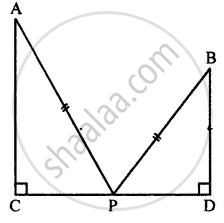
In the given figure, angle ACP = ∠BDP = 90°, AC = 12 m, BD = 9 m and PA= PB = 15 m. Find:
(i) CP
(ii) PD
(iii) CD
Find the unknown side in the following triangles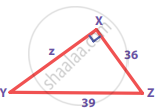
Foot of a 10 m long ladder leaning against a vertical wall is 6 m away from the base of the wall. Find the height of the point on the wall where the top of the ladder reaches.
In a quadrilateral ABCD, ∠A + ∠D = 90°. Prove that AC2 + BD2 = AD2 + BC2
[Hint: Produce AB and DC to meet at E.]
