हिंदी

In ∆PQR, point S is the midpoint of side QR. If PQ = 11, PR = 17, PS = 13, find QR. - Geometry Mathematics 2

Advertisements
Advertisements

प्रश्न

In ∆PQR, point S is the midpoint of side QR. If PQ = 11, PR = 17, PS = 13, find QR.

योग
Advertisements

उत्तर
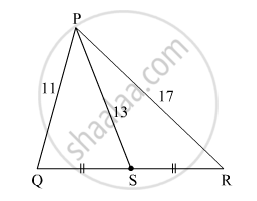
In ∆PQR, point S is the midpoint of side QR.

\[QS = SR = \frac{1}{2}QR\]

\[{PQ}^2 + {PR}^2 = 2 {PS}^2 + 2 {QS}^2\] .......…[Apollonius theorem]

\[ \Rightarrow {11}^2 + {17}^2 = 2 \left( 13 \right)^2 + 2 {QS}^2 \]

\[ \Rightarrow 121 + 289 = 2\left( 169 \right) + 2 {QS}^2 \]

\[ \Rightarrow 410 = 338 + 2 {QS}^2 \]

\[ \Rightarrow 2 {QS}^2 = 410 - 338\]

\[ \Rightarrow 2 {QS}^2 = 72\]

\[ \Rightarrow {QS}^2 = 36\]

\[ \Rightarrow QS = 6\]

\[ \therefore QR = 2 \times QS\]

\[ = 2 \times 6\]

\[ = 12\]

Hence, QR = 12.

shaalaa.com
  क्या इस प्रश्न या उत्तर में कोई त्रुटि है?
अध्याय 2: Pythagoras Theorem - Practice Set 2.2 [पृष्ठ ४३]

APPEARS IN

बालभारती Mathematics 2 [English] Standard 10 Maharashtra State Board
अध्याय 2 Pythagoras Theorem
Practice Set 2.2 | Q 1 | पृष्ठ ४३

वीडियो ट्यूटोरियलVIEW ALL [1]

संबंधित प्रश्न

ABCD is a rectangle whose three vertices are B (4, 0), C(4, 3) and D(0,3). The length of one of its diagonals is 
(A) 5
(B) 4
(C) 3
(D) 25


In a right triangle ABC, right-angled at B, BC = 12 cm and AB = 5 cm. The radius of the circle inscribed in the triangle (in cm) is
(A) 4
(B) 3
(C) 2
(D) 1


Prove that the diagonals of a rectangle ABCD, with vertices A(2, -1), B(5, -1), C(5, 6) and D(2, 6), are equal and bisect each other.


Side of a triangle is given, determine it is a right triangle.

`(2a – 1) cm, 2\sqrt { 2a } cm, and (2a + 1) cm`


In Fig., ∆ABC is an obtuse triangle, obtuse angled at B. If AD ⊥ CB, prove that AC2 = AB2 + BC2 + 2BC × BD


ABC is a right-angled triangle, right-angled at A. A circle is inscribed in it. The lengths of the two sides containing the right angle are 5 cm and 12 cm. Find the radius of the circle


The perpendicular AD on the base BC of a ∆ABC intersects BC at D so that DB = 3 CD. Prove that `2"AB"^2 = 2"AC"^2 + "BC"^2`


Sides of triangle are given below. Determine it is a right triangle or not? In case of a right triangle, write the length of its hypotenuse. 50 cm, 80 cm, 100 cm


Two poles of heights 6 m and 11 m stand on a plane ground. If the distance between the feet of the poles is 12 m, find the distance between their tops.


In ∆ABC, AB = 10, AC = 7, BC = 9, then find the length of the median drawn from point C to side AB.


In the given figure, ∠B = 90°, XY || BC, AB = 12 cm, AY = 8cm and AX : XB = 1 : 2 = AY : YC.

Find the lengths of AC and BC.


In the following figure, AD is perpendicular to BC and D divides BC in the ratio 1: 3.

Prove that : 2AC2 = 2AB2 + BC2


A ladder, 6.5 m long, rests against a vertical wall. If the foot of the ladder is 2.5 m from the foot of the wall, find up to how much height does the ladder reach?


Find the Pythagorean triplet from among the following set of numbers.

4, 5, 6


Find the Pythagorean triplet from among the following set of numbers.

4, 7, 8


Find the length of the hypotenuse of a triangle whose other two sides are 24cm and 7cm.


Two poles of height 9m and 14m stand on a plane ground. If the distance between their 12m, find the distance between their tops.


In triangle ABC, line I, is a perpendicular bisector of BC.
If BC = 12 cm, SM = 8 cm, find CS


In the given figure, ∠T and ∠B are right angles. If the length of AT, BC and AS (in centimeters) are 15, 16, and 17 respectively, then the length of TC (in centimeters) is ______.


The foot of a ladder is 6 m away from its wall and its top reaches a window 8 m above the ground. If the ladder is shifted in such a way that its foot is 8 m away from the wall, to what height does its top reach?


Share
Notifications

Englishहिंदीमराठी


      Forgot password?
Use app×