Advertisements
Advertisements
प्रश्न
The sides of the triangle are given below. Find out which one is the right-angled triangle?
11, 60, 61
Advertisements
उत्तर
It is known that, if in a triplet of natural numbers, the square of the biggest number is equal to the sum of the squares of the other two numbers, then the three numbers form a Pythagorean triplet. If the lengths of the sides of a triangle form such a triplet, then the triangle is a right-angled triangle.
The sides of the given triangle are 11, 60, and 61.
Let us check whether the given set (11, 60, 61) forms a Pythagorean triplet or not.
The biggest number among the given set is 61.
(61)2 = 3721; (11)2 = 121; (60)2 = 3600
Now, 121 + 3600 = 3721
∴ (11)2 + (60)2 = (61)2
Thus, (11, 60, 61) forms a Pythagorean triplet.
Hence, the given triangle with sides 11, 60, and 61 is a right-angled triangle.
APPEARS IN
संबंधित प्रश्न
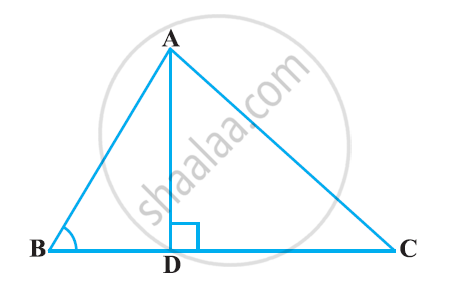
In the given figure, ABC is a triangle in which ∠ABC < 90° and AD ⊥ BC. Prove that AC2 = AB2 + BC2 − 2BC.BD.
Pranali and Prasad started walking to the East and to the North respectively, from the same point and at the same speed. After 2 hours distance between them was \[15\sqrt{2}\]
km. Find their speed per hour.
A ladder, 6.5 m long, rests against a vertical wall. If the foot of the ladder is 2.5 m from the foot of the wall, find up to how much height does the ladder reach?
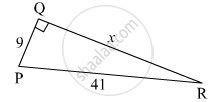
In the figure below, find the value of 'x'.
Find the Pythagorean triplet from among the following set of numbers.
3, 4, 5
In a right angled triangle, the hypotenuse is the greatest side
A flag pole 18 m high casts a shadow 9.6 m long. Find the distance of the top of the pole from the far end of the shadow.
In ∆PQR, PD ⊥ QR such that D lies on QR. If PQ = a, PR = b, QD = c and DR = d, prove that (a + b)(a – b) = (c + d)(c – d).
Jayanti takes shortest route to her home by walking diagonally across a rectangular park. The park measures 60 metres × 80 metres. How much shorter is the route across the park than the route around its edges?
Two poles of 10 m and 15 m stand upright on a plane ground. If the distance between the tops is 13 m, find the distance between their feet.
