Advertisements
Advertisements
प्रश्न
Find the unknown side in the following triangles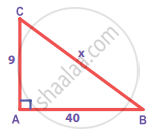
Advertisements
उत्तर
From ∆ABC, by Pythagoras theorem
BC2 = AB2 + AC2
Take AB2 + AC2
= 92 + 402
= 81 + 1600
= 1681
BC2 = AB2 + AC2
= 1681
= 412
BC2 = 412
⇒ BC = 41
∴ x = 41
APPEARS IN
संबंधित प्रश्न
In an equilateral triangle ABC, D is a point on side BC such that BD = `1/3BC` . Prove that 9 AD2 = 7 AB2
Identify, with reason, if the following is a Pythagorean triplet.
(4, 9, 12)
In ∆PQR, point S is the midpoint of side QR. If PQ = 11, PR = 17, PS = 13, find QR.
In the given figure, ∠B = 90°, XY || BC, AB = 12 cm, AY = 8cm and AX : XB = 1 : 2 = AY : YC.
Find the lengths of AC and BC.

A right triangle has hypotenuse p cm and one side q cm. If p - q = 1, find the length of third side of the triangle.
The foot of a ladder is 6m away from a wall and its top reaches a window 8m above the ground. If the ladder is shifted in such a way that its foot is 8m away from the wall to what height does its tip reach?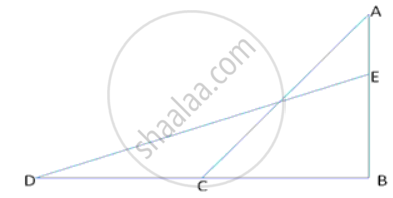
Find the unknown side in the following triangles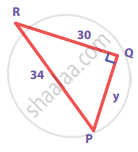
In figure, PQR is a right triangle right angled at Q and QS ⊥ PR. If PQ = 6 cm and PS = 4 cm, find QS, RS and QR.
Lengths of sides of a triangle are 3 cm, 4 cm and 5 cm. The triangle is ______.
Two squares are congruent, if they have same ______.
