Advertisements
Advertisements
प्रश्न
Find the unknown side in the following triangles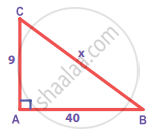
Advertisements
उत्तर
From ∆ABC, by Pythagoras theorem
BC2 = AB2 + AC2
Take AB2 + AC2
= 92 + 402
= 81 + 1600
= 1681
BC2 = AB2 + AC2
= 1681
= 412
BC2 = 412
⇒ BC = 41
∴ x = 41
APPEARS IN
संबंधित प्रश्न
A ladder 10 m long reaches a window 8 m above the ground. Find the distance of the foot of the ladder from base of the wall.
Pranali and Prasad started walking to the East and to the North respectively, from the same point and at the same speed. After 2 hours distance between them was \[15\sqrt{2}\]
km. Find their speed per hour.
In the figure, given below, AD ⊥ BC.
Prove that: c2 = a2 + b2 - 2ax.
Triangle ABC is right-angled at vertex A. Calculate the length of BC, if AB = 18 cm and AC = 24 cm.
In triangle PQR, angle Q = 90°, find: PQ, if PR = 34 cm and QR = 30 cm
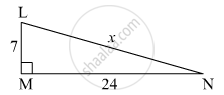
In the figure below, find the value of 'x'.
A right triangle has hypotenuse p cm and one side q cm. If p - q = 1, find the length of third side of the triangle.
In a triangle ABC, AC > AB, D is the midpoint BC, and AE ⊥ BC. Prove that: AC2 = AD2 + BC x DE + `(1)/(4)"BC"^2`
In the given figure. PQ = PS, P =R = 90°. RS = 20 cm and QR = 21 cm. Find the length of PQ correct to two decimal places.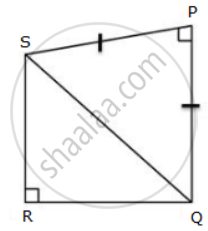
In a right-angled triangle ABC, if angle B = 90°, then which of the following is true?
