Advertisements
Advertisements
प्रश्न
The sides of a certain triangle is given below. Find, which of them is right-triangle
6 m, 9 m, and 13 m
Advertisements
उत्तर
6 m, 9 m, and 13 m
The given triangle will be a right-angled triangle if the square of its largest side is equal to the sum of the squares on the other two sides.
i.e., If (13)2 = (9)2 + (6)2
169 = 81 + 36 = 169 ≠ 117
So, the given triangle is not right-angled.
APPEARS IN
संबंधित प्रश्न
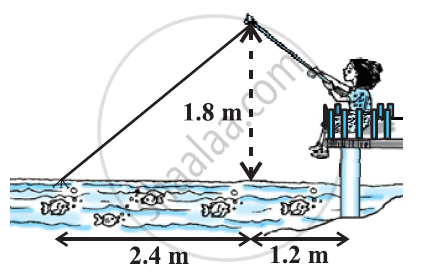
Nazima is fly fishing in a stream. The tip of her fishing rod is 1.8 m above the surface of the water and the fly at the end of the string rests on the water 3.6 m away and 2.4 m from a point directly under the tip of the rod. Assuming that her string (from the tip of her rod to the fly) is taut, how much string does she have out (see Figure)? If she pulls in the string at the rate of 5 cm per second, what will be the horizontal distance of the fly from her after 12 seconds?
In triangle ABC, ∠B = 90o and D is the mid-point of BC.
Prove that: AC2 = AD2 + 3CD2.
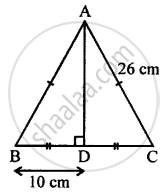
In the given figure, angle ADB = 90°, AC = AB = 26 cm and BD = DC. If the length of AD = 24 cm; find the length of BC.
A boy first goes 5 m due north and then 12 m due east. Find the distance between the initial and the final position of the boy.
The sides of the triangle are given below. Find out which one is the right-angled triangle?
1.5, 1.6, 1.7
In a triangle ABC, AC > AB, D is the midpoint BC, and AE ⊥ BC. Prove that: AB2 + AC2 = 2AD2 + `(1)/(2)"BC"^2`
In the given figure, PQ = `"RS"/(3)` = 8cm, 3ST = 4QT = 48cm.
SHow that ∠RTP = 90°.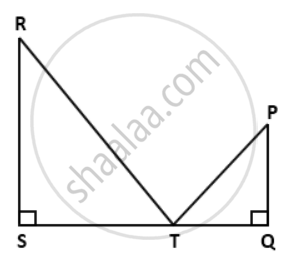
Find the unknown side in the following triangles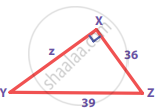
Two rectangles are congruent, if they have same ______ and ______.
The hypotenuse (in cm) of a right angled triangle is 6 cm more than twice the length of the shortest side. If the length of third side is 6 cm less than thrice the length of shortest side, then find the dimensions of the triangle.
