Advertisements
Advertisements
प्रश्न
Two rectangles are congruent, if they have same ______ and ______.
Advertisements
उत्तर
Two rectangles are congruent, if they have same length and breadth.
Explanation:
In geometry, congruent figures are those that have the same shape and size.
-
For rectangles to be congruent, their lengths and breadths (widths) must be exactly equal.
-
This ensures that all corresponding sides and angles are equal.
-
Even if one rectangle is rotated or flipped, as long as the length and breadth match, the rectangles are considered congruent.
Example:
If one rectangle is 6 cm long and 4 cm wide, and another is also 6 cm long and 4 cm wide, then they are congruent rectangles.
APPEARS IN
संबंधित प्रश्न
In the following figure, O is a point in the interior of a triangle ABC, OD ⊥ BC, OE ⊥ AC and OF ⊥ AB. Show that
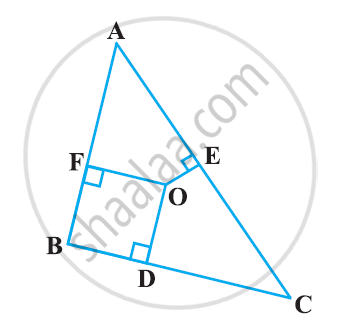
(i) OA2 + OB2 + OC2 − OD2 − OE2 − OF2 = AF2 + BD2 + CE2
(ii) AF2 + BD2 + CE2 = AE2 + CD2 + BF2
In an equilateral triangle ABC, D is a point on side BC such that BD = `1/3BC` . Prove that 9 AD2 = 7 AB2
Identify, with reason, if the following is a Pythagorean triplet.
(4, 9, 12)
O is any point inside a rectangle ABCD.
Prove that: OB2 + OD2 = OC2 + OA2.
In the given figure, BL and CM are medians of a ∆ABC right-angled at A. Prove that 4 (BL2 + CM2) = 5 BC2.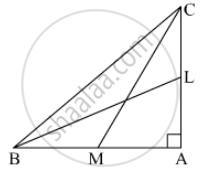
AD is perpendicular to the side BC of an equilateral ΔABC. Prove that 4AD2 = 3AB2.
The perpendicular PS on the base QR of a ∆PQR intersects QR at S, such that QS = 3 SR. Prove that 2PQ2 = 2PR2 + QR2
From the given figure, in ∆ABQ, if AQ = 8 cm, then AB = ?
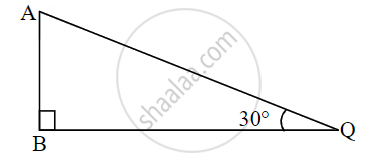
Lengths of sides of a triangle are 3 cm, 4 cm and 5 cm. The triangle is ______.
Jayanti takes shortest route to her home by walking diagonally across a rectangular park. The park measures 60 metres × 80 metres. How much shorter is the route across the park than the route around its edges?
