Advertisements
Advertisements
प्रश्न
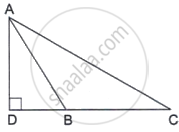
In ∆ABC, seg AD ⊥ seg BC, DB = 3CD.
Prove that: 2AB2 = 2AC2 + BC2

Advertisements
उत्तर
In ∆ABC, AD ⊥ BC, and BD = 3CD ...(Given)
In ∆ADC, ∠ADC = 90°
By Pythagoras’ theorem,
AC2 = AD2 + CD2
2AC2 = 2AD2 − 2CD2 ...(1) [Multiplied by 2]
In ∆ADB, ∠ADB = 90°
by Pythagoras’ theorem,
AB2 = AD2 + BD2
2AB2 = 2AD2 + 2BD2 ...(2) [Multiplied by 2]
Subtracting equation (1) from (2)
2AB2 − AC2 = (2AD2 + 2BD2) − (2AD2 + 2CD2)
= 2AD2 + 2BD2 − 2AD2 − 2CD2
= 2(3CD)2 − 2CD2
= 2 × 9CD2 − 2CD2 ...[Given]
= 18CD2 − 2CD2
= 16CD2
∴ 2AB2 − 2AC2 = 16CD2 ...(3)
BC = CD + DB [C−D−B]
BC = CD + 3CD = 4CD
BC2 = 16 CD2 ...(4) [squaring both sides]
From (3) & (4)
2AB2 − 2AC2 = BC2
∴ 2AB2 = 2AC2 + BC2
APPEARS IN
संबंधित प्रश्न
In the given figure, ∆ABC is an obtuse triangle, obtuse-angled at B. If AD ⊥ CB (produced) prove that AC2 = AB2 + BC2 + 2BC · BD.
Sides of triangles are given below. Determine it is a right triangles? In case of a right triangle, write the length of its hypotenuse. 3 cm, 8 cm, 6 cm
D and E are points on the sides CA and CB respectively of a triangle ABC right angled at C. Prove that AE2 + BD2 = AB2 + DE2
Prove that, in a right-angled triangle, the square of the hypotenuse is equal to the sum of the square of remaining two sides.
In triangle ABC, given below, AB = 8 cm, BC = 6 cm and AC = 3 cm. Calculate the length of OC.

Choose the correct alternative:
In right-angled triangle PQR, if hypotenuse PR = 12 and PQ = 6, then what is the measure of ∠P?
If P and Q are the points on side CA and CB respectively of ΔABC, right angled at C, prove that (AQ2 + BP2 ) = (AB2 + PQ2)
The sides of a certain triangle is given below. Find, which of them is right-triangle
16 cm, 20 cm, and 12 cm
A ladder, 6.5 m long, rests against a vertical wall. If the foot of the ladder is 2.5 m from the foot of the wall, find up to how much height does the ladder reach?
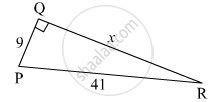
In the figure below, find the value of 'x'.
Find the Pythagorean triplet from among the following set of numbers.
3, 4, 5
In a triangle ABC, AC > AB, D is the midpoint BC, and AE ⊥ BC. Prove that: AB2 = AD2 - BC x CE + `(1)/(4)"BC"^2`
In a triangle ABC, AC > AB, D is the midpoint BC, and AE ⊥ BC. Prove that: AB2 + AC2 = 2(AD2 + CD2)
In a right-angled triangle PQR, right-angled at Q, S and T are points on PQ and QR respectively such as PT = SR = 13 cm, QT = 5 cm and PS = TR. Find the length of PQ and PS.
In a square PQRS of side 5 cm, A, B, C and D are points on sides PQ, QR, RS and SP respectively such as PA = PD = RB = RC = 2 cm. Prove that ABCD is a rectangle. Also, find the area and perimeter of the rectangle.
Find the unknown side in the following triangles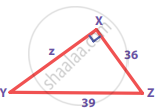
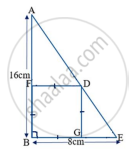
Sides AB and BE of a right triangle, right-angled at B are of lengths 16 cm and 8 cm respectively. The length of the side of largest square FDGB that can be inscribed in the triangle ABE is ______.
In figure, PQR is a right triangle right angled at Q and QS ⊥ PR. If PQ = 6 cm and PS = 4 cm, find QS, RS and QR.
Two squares having same perimeter are congruent.
If the hypotenuse of one right triangle is equal to the hypotenuse of another right triangle, then the triangles are congruent.
