Advertisements
Advertisements
प्रश्न
In ∆ABC, ∠BAC = 90°, seg BL and seg CM are medians of ∆ABC. Then prove that:
4(BL2 + CM2) = 5 BC2

Advertisements
उत्तर
Given: Δ ABC right angled at A, i.e., A = 90, where BL and CM are the medians.
To Prove: 4(BL2 + CM2) = 5BC2
Proof:
Since BL is the median,
AL = CL = `1/2` AC ...(1)
Similarly, CM is the median
AM = MB = `1/2`AB ...(2)
∴ by Pythagoras theorem,
(Hypotenuse)2 = (Height)2 + (Base)2 ...(3)
In ΔBAC,
(BC)2 = (AB)2 + (AC)2 ...(4)
∠BAC = 90°
In ΔBAL,
(BL)2 = AB2 + AL2 ...(From 1)
BL2 = AB2 + `(("AC")/2)^2`
BL2 = AB2 + `("AC"^2/4)`
Multiply both sides by 4,
4BL2 = 4AB2 + AC2 ...(5)
In ΔMAC,
CM2 = AM2 + AC2 ...(From 2)
CM2 = `(("AB")/2)^2` + AC2
CM2 = `("AB")^2/4` + AC2
Multiply both sides by 4,
4CM2 = AB2 + 4AC2 ...(6)
Adding 5 and 6,
4BL2 + 4CM2 = (4AB2 + AC2) + (AB2 + 4AC2)
4(BL2 + CM2) = 5AB2 + 5AC2
∴ 4(BL2 + CM2) = 5BC2
Hence, proved.
APPEARS IN
संबंधित प्रश्न
A ladder leaning against a wall makes an angle of 60° with the horizontal. If the foot of the ladder is 2.5 m away from the wall, find the length of the ladder
Side of a triangle is given, determine it is a right triangle.
`(2a – 1) cm, 2\sqrt { 2a } cm, and (2a + 1) cm`
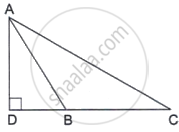
In the given figure, ∆ABC is an obtuse triangle, obtuse-angled at B. If AD ⊥ CB (produced) prove that AC2 = AB2 + BC2 + 2BC · BD.
From a point O in the interior of a ∆ABC, perpendicular OD, OE and OF are drawn to the sides BC, CA and AB respectively. Prove
that :
`(i) AF^2 + BD^2 + CE^2 = OA^2 + OB^2 + OC^2 – OD^2 – OE^2 – OF^2`
`(ii) AF^2 + BD^2 + CE^2 = AE^2 + CD^2 + BF^2`
A tree is broken at a height of 5 m from the ground and its top touches the ground at a distance of 12 m from the base of the tree. Find the original height of the tree.
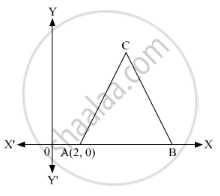
In the given figure, ∆ABC is an equilateral triangle of side 3 units. Find the coordinates of the other two vertices ?
In ∆ABC, seg AD ⊥ seg BC, DB = 3CD.
Prove that: 2AB2 = 2AC2 + BC2

A man goes 40 m due north and then 50 m due west. Find his distance from the starting point.
In triangle ABC, given below, AB = 8 cm, BC = 6 cm and AC = 3 cm. Calculate the length of OC.

In the figure, given below, AD ⊥ BC.
Prove that: c2 = a2 + b2 - 2ax.
In triangle ABC, angle A = 90o, CA = AB and D is the point on AB produced.
Prove that DC2 - BD2 = 2AB.AD.
If the angles of a triangle are 30°, 60°, and 90°, then shown that the side opposite to 30° is half of the hypotenuse, and the side opposite to 60° is `sqrt(3)/2` times of the hypotenuse.
In triangle PQR, angle Q = 90°, find: PR, if PQ = 8 cm and QR = 6 cm
Rithika buys an LED TV which has a 25 inches screen. If its height is 7 inches, how wide is the screen? Her TV cabinet is 20 inches wide. Will the TV fit into the cabinet? Give reason
From given figure, In ∆ABC, If AC = 12 cm, then AB = ?
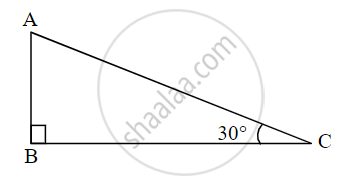
Activity: From given figure, In ∆ABC, ∠ABC = 90°, ∠ACB = 30°
∴ ∠BAC = `square`
∴ ∆ABC is 30° – 60° – 90° triangle.
∴ In ∆ABC by property of 30° – 60° – 90° triangle.
∴ AB = `1/2` AC and `square` = `sqrt(3)/2` AC
∴ `square` = `1/2 xx 12` and BC = `sqrt(3)/2 xx 12`
∴ `square` = 6 and BC = `6sqrt(3)`
In the given figure, ∠T and ∠B are right angles. If the length of AT, BC and AS (in centimeters) are 15, 16, and 17 respectively, then the length of TC (in centimeters) is ______.

Prove that the area of the equilateral triangle drawn on the hypotenuse of a right angled triangle is equal to the sum of the areas of the equilateral triangles drawn on the other two sides of the triangle.
The perimeter of the rectangle whose length is 60 cm and a diagonal is 61 cm is ______.
In a right-angled triangle ABC, if angle B = 90°, then which of the following is true?
Two poles of 10 m and 15 m stand upright on a plane ground. If the distance between the tops is 13 m, find the distance between their feet.
