हिंदी

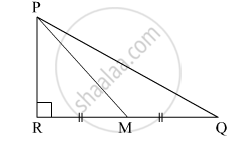
In the given figure, M is the midpoint of QR. ∠PRQ = 90°. Prove that, PQ2 = 4PM2 – 3PR2 - Geometry Mathematics 2

Advertisements
Advertisements

प्रश्न

In the given figure, M is the midpoint of QR. ∠PRQ = 90°. Prove that, PQ= 4PM– 3PR2.

योग
Advertisements

उत्तर

Given: M is the midpoint of QR. ∠PRQ = 90°.

To prove: PQ= 4PM– 3PR2

Proof: 

In ∆PRM,
∠PRM = 90°                        ...(Given)
By Pythagoras theorem,
∴ PM2 = PR2 + RM2
∴ RM2 = PM2 − PR2             ...(1)

In ∆PRQ,
∠PRQ = 90°                       ...(Given)
By Pythagoras theorem,
∴ PQ2 = PR2 + RQ2
∴ PQ2 = PR2 + (RM + MQ)2        ...[M is the midpoint of QR]
∴ PQ2 = PR2 + (RM + RM)2
∴ PQ2 = PR2 + (2RM)2
∴ PQ2 = PR2 + 4RM2
∴ PQ2 = PR2 + 4(PM2 − PR2)             ...(from 1)
∴ PQ2 = PR2 + 4PM2 − 4PR2
∴ PQ2 = 4PM2 − 3PR2

Hence, PQ= 4PM– 3PR2.

shaalaa.com
  क्या इस प्रश्न या उत्तर में कोई त्रुटि है?
अध्याय 2: Pythagoras Theorem - Practice Set 2.1 [पृष्ठ ३९]

APPEARS IN

बालभारती Mathematics 2 [English] Standard 10 Maharashtra State Board
अध्याय 2 Pythagoras Theorem
Practice Set 2.1 | Q 9 | पृष्ठ ३९

वीडियो ट्यूटोरियलVIEW ALL [1]

संबंधित प्रश्न

ABCD is a rectangle whose three vertices are B (4, 0), C(4, 3) and D(0,3). The length of one of its diagonals is 
(A) 5
(B) 4
(C) 3
(D) 25


Side of a triangle is given, determine it is a right triangle.

`(2a – 1) cm, 2\sqrt { 2a } cm, and (2a + 1) cm`


In a ∆ABC, AD ⊥ BC and AD2 = BC × CD. Prove ∆ABC is a right triangle


Prove that the sum of the squares of the sides of a rhombus is equal to the sum of the squares of its diagonals


For finding AB and BC with the help of information given in the figure, complete following activity.

AB = BC ..........

∴ ∠BAC =

∴ AB = BC = × AC

                 = × `sqrt8`

                 = × `2sqrt2`

                 =


In the given figure, ∠DFE = 90°, FG ⊥ ED, If GD = 8, FG = 12, find (1) EG (2) FD and (3) EF


Find the length diagonal of a rectangle whose length is 35 cm and breadth is 12 cm.


In ∆ABC, ∠BAC = 90°, seg BL and seg CM are medians of ∆ABC. Then prove that:
4(BL+ CM2) = 5 BC2


A ladder 13 m long rests against a vertical wall. If the foot of the ladder is 5 m from the foot of the wall, find the distance of the other end of the ladder from the ground.


In the given figure, ∠B = 90°, XY || BC, AB = 12 cm, AY = 8cm and AX : XB = 1 : 2 = AY : YC.

Find the lengths of AC and BC.


In triangle ABC, given below, AB = 8 cm, BC = 6 cm and AC = 3 cm. Calculate the length of OC.


Prove that in a right angle triangle, the square of the hypotenuse is equal to the sum of squares of the other two sides.


From the given figure, find the length of hypotenuse AC and the perimeter of ∆ABC.


A man goes 10 m due east and then 24 m due north. Find the distance from the straight point.


In the given figure, PQ = `"RS"/(3)` = 8cm, 3ST = 4QT = 48cm.
SHow that ∠RTP = 90°.


Find the unknown side in the following triangles


If ΔABC ~ ΔPQR, `("ar" triangle "ABC")/("ar" triangle "PQR") = 9/4` and AB = 18 cm, then the length of PQ is ______.


Is the triangle with sides 25 cm, 5 cm and 24 cm a right triangle? Give reasons for your answer.


The perimeter of the rectangle whose length is 60 cm and a diagonal is 61 cm is ______.


The longest side of a right angled triangle is called its ______.


Share
Notifications

Englishहिंदीमराठी


      Forgot password?
Use app×