हिंदी

A Ladder 13 M Long Rests Against a Vertical Wall. If the Foot of the Ladder is 5 M from the Foot of the Wall, Find the Distance of the Other End of the Ladder from the Ground

Advertisements
Advertisements

प्रश्न

A ladder 13 m long rests against a vertical wall. If the foot of the ladder is 5 m from the foot of the wall, find the distance of the other end of the ladder from the ground.

योग
Advertisements

उत्तर

The pictorial representation of the given problem is given below,
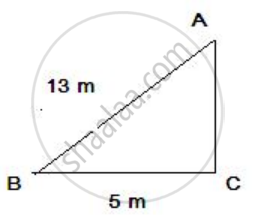
Pythagoras theorem states that in a right-angled triangle, the square on the hypotenuse is equal to the sum of the squares on the remaining two sides.

Here, AB is the hypotenuse.
Therefore applying the Pythagoras theorem we get,
AB2  = BC2 + CA2 
132 = 52 + CA2 
CA2 = 132 -  52 
CA2  = 144
CA = 12 m
Therefore, the distance of the other end of the ladder from the ground is 12m.

shaalaa.com
  क्या इस प्रश्न या उत्तर में कोई त्रुटि है?
अध्याय 13: Pythagoras Theorem [Proof and Simple Applications with Converse] - Exercise 13 (A) [पृष्ठ १५८]

APPEARS IN

सेलिना Concise Mathematics [English] Class 9 ICSE
अध्याय 13 Pythagoras Theorem [Proof and Simple Applications with Converse]
Exercise 13 (A) | Q 1 | पृष्ठ १५८

संबंधित प्रश्न

If the sides of a triangle are 6 cm, 8 cm and 10 cm, respectively, then determine whether the triangle is a right angle triangle or not.


In triangle ABC, ∠C=90°. Let BC= a, CA= b, AB= c and let 'p' be the length of the perpendicular from 'C' on AB, prove that:

1. cp = ab

2. `1/p^2=1/a^2+1/b^2`


In a right triangle ABC right-angled at C, P and Q are the points on the sides CA and CB respectively, which divide these sides in the ratio 2 : 1. Prove that

`(i) 9 AQ^2 = 9 AC^2 + 4 BC^2`

`(ii) 9 BP^2 = 9 BC^2 + 4 AC^2`

`(iii) 9 (AQ^2 + BP^2 ) = 13 AB^2`


ABC is an isosceles triangle right angled at C. Prove that AB2 = 2AC2 


In an isosceles triangle, length of the congruent sides is 13 cm and its base is 10 cm. Find the distance between the vertex opposite the base and the centroid.


In the figure: ∠PSQ = 90o, PQ = 10 cm, QS = 6 cm and RQ = 9 cm. Calculate the length of PR.


Diagonals of rhombus ABCD intersect each other at point O.

Prove that: OA2 + OC2 = 2AD2 - `"BD"^2/2`


In the following figure, OP, OQ, and OR are drawn perpendiculars to the sides BC, CA and AB respectively of triangle ABC.

Prove that: AR2 + BP2 + CQ2 = AQ2 + CP2 + BR2


Prove that in a right angle triangle, the square of the hypotenuse is equal to the sum of squares of the other two sides.


In the figure below, find the value of 'x'.


The sides of the triangle are given below. Find out which one is the right-angled triangle?

11, 60, 61


Each side of rhombus is 10cm. If one of its diagonals is 16cm, find the length of the other diagonals.


In ΔABC, AD is perpendicular to BC. Prove that: AB2 + CD2 = AC2 + BD2


In a triangle ABC, AC > AB, D is the midpoint BC, and AE ⊥ BC. Prove that: AC2 = AD2 + BC x DE + `(1)/(4)"BC"^2`


In a right-angled triangle ABC,ABC = 90°, AC = 10 cm, BC = 6 cm and BC produced to D such CD = 9 cm. Find the length of AD.


Two trains leave a railway station at the same time. The first train travels due west and the second train due north. The first train travels at a speed of `(20 "km")/"hr"` and the second train travels at `(30 "km")/"hr"`. After 2 hours, what is the distance between them?


Rithika buys an LED TV which has a 25 inches screen. If its height is 7 inches, how wide is the screen? Her TV cabinet is 20 inches wide. Will the TV fit into the cabinet? Give reason


From the given figure, in ∆ABQ, if AQ = 8 cm, then AB =?


In figure, PQR is a right triangle right angled at Q and QS ⊥ PR. If PQ = 6 cm and PS = 4 cm, find QS, RS and QR.


In ∆PQR, PD ⊥ QR such that D lies on QR. If PQ = a, PR = b, QD = c and DR = d, prove that (a + b)(a – b) = (c + d)(c – d).


Share
Notifications

Englishहिंदीमराठी


      Forgot password?
Use app×