Advertisements
Advertisements
प्रश्न
In ΔABC, Find the sides of the triangle, if:
- AB = ( x - 3 ) cm, BC = ( x + 4 ) cm and AC = ( x + 6 ) cm
- AB = x cm, BC = ( 4x + 4 ) cm and AC = ( 4x + 5) cm
Advertisements
उत्तर
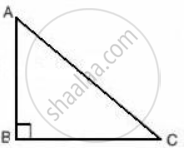
(i) In right-angled ΔABC,
AC2 = AB2 + BC2
⇒ ( x + 6 )2 = ( x - 3 )2 + ( x + 4 )2
⇒ ( x2 + 12x + 36 ) = ( x2 - 6x + 9 ) + ( x2 + 8x + 16 )
⇒ x2 - 10x - 11 = 0
⇒ ( x - 11 )( x + 1 ) = 0
⇒ x = 11 or x = - 1
But length of the side of a triangle can not be negative.
⇒ x = 11 cm
∴ AB = ( x - 3 ) = ( 11 - 3 ) = 8 cm
BC = ( x + 4 ) = ( 11 + 4 ) = 15 cm
AC = ( x + 6 ) = ( 11 + 6 ) = 17 cm.
(ii) In right-angled ΔABC,
AC2 = AB2 + BC2
⇒ ( 4x + 5 )2 = ( x )2 + ( 4x + 4 )2
⇒ ( 16x2 + 40x + 25 ) = ( x2 ) + ( 16x2 + 32x + 16 )
⇒ x2 - 8x - 9 = 0
⇒ ( x - 9 )( x + 1 ) = 0
⇒ x = 9 or x = - 1
But length of the side of a triangle can not be negative.
⇒ x = 9 cm
∴ AB = x = 9 cm
BC = ( 4x + 4 ) = ( 36 + 4 ) = 40 cm
AC = ( 4x + 5 ) = ( 36 + 5 ) = 41 cm.
APPEARS IN
संबंधित प्रश्न
Prove that the sum of the squares of the diagonals of parallelogram is equal to the sum of the squares of its sides.
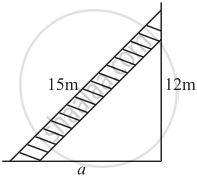
A 15 m long ladder reached a window 12 m high from the ground on placing it against a wall at a distance a. Find the distance of the foot of the ladder from the wall.
Which of the following can be the sides of a right triangle?
2 cm, 2 cm, 5 cm
In the case of right-angled triangles, identify the right angles.
Identify, with reason, if the following is a Pythagorean triplet.
(11, 60, 61)
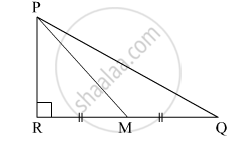
In the given figure, M is the midpoint of QR. ∠PRQ = 90°. Prove that, PQ2 = 4PM2 – 3PR2.
Pranali and Prasad started walking to the East and to the North respectively, from the same point and at the same speed. After 2 hours distance between them was \[15\sqrt{2}\]
km. Find their speed per hour.
A ladder 13 m long rests against a vertical wall. If the foot of the ladder is 5 m from the foot of the wall, find the distance of the other end of the ladder from the ground.
Find the value of (sin2 33 + sin2 57°)
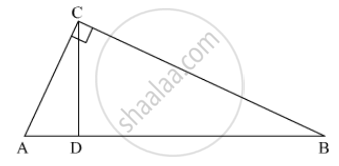
In Fig. 3, ∠ACB = 90° and CD ⊥ AB, prove that CD2 = BD x AD.
The sides of a certain triangle is given below. Find, which of them is right-triangle
6 m, 9 m, and 13 m
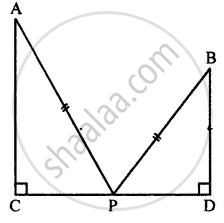
In the given figure, angle ACP = ∠BDP = 90°, AC = 12 m, BD = 9 m and PA= PB = 15 m. Find:
(i) CP
(ii) PD
(iii) CD
A ladder 15m long reaches a window which is 9m above the ground on one side of a street. Keeping its foot at the same point, the ladder is turned to other side of the street to reach a window 12m high. Find the width of the street.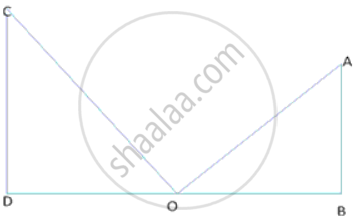
In a triangle ABC right angled at C, P and Q are points of sides CA and CB respectively, which divide these sides the ratio 2 : 1.
Prove that: 9AQ2 = 9AC2 + 4BC2
In the given figure, PQ = `"RS"/(3)` = 8cm, 3ST = 4QT = 48cm.
SHow that ∠RTP = 90°.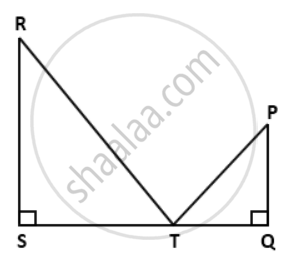
Find the unknown side in the following triangles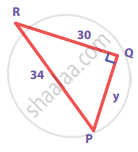
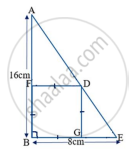
Sides AB and BE of a right triangle, right-angled at B are of lengths 16 cm and 8 cm respectively. The length of the side of largest square FDGB that can be inscribed in the triangle ABE is ______.
Prove that the area of the semicircle drawn on the hypotenuse of a right angled triangle is equal to the sum of the areas of the semicircles drawn on the other two sides of the triangle.
In the given figure, AD is a median of a triangle ABC and AM ⊥ BC. Prove that:
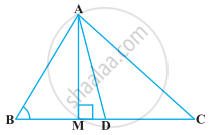
(i) `"AC"^2 = "AD"^2 + "BC"."DM" + (("BC")/2)^2`
(ii) `"AB"^2 = "AD"^2 - "BC"."DM" + (("BC")/2)^2`
(iii) `"AC"^2 + "AB"^2 = 2"AD"^2 + 1/2"BC"^2`
In an isosceles triangle PQR, the length of equal sides PQ and PR is 13 cm and base QR is 10 cm. Find the length of perpendicular bisector drawn from vertex P to side QR.
