Advertisements
Advertisements
प्रश्न
The sides of the triangle are given below. Find out which one is the right-angled triangle?
11, 12, 15
Advertisements
उत्तर
It is known that, if in a triplet of natural numbers, the square of the biggest number is equal to the sum of the squares of the other two numbers, then the three numbers form a Pythagorean triplet. If the lengths of the sides of a triangle form such a triplet, then the triangle is a right-angled triangle.
The sides of the given triangle are 11, 12, and 15.
Let us check whether the given set (11, 12, 15) forms a Pythagorean triplet or not.
The biggest number among the given set is 15.
(15)2 = 225; (11)2 = 121; (12)2 = 144
Now, 121 + 144 = 265 ≠ 225
∴ (11)2 + (12)2 ≠ (15)2
Thus, (11, 12, 15) does not form a Pythagorean triplet.
Hence, the given triangle with sides 8, 15, and 17 is not a right-angled triangle.
संबंधित प्रश्न
A man goes 10 m due east and then 24 m due north. Find the distance from the starting point
A man goes 40 m due north and then 50 m due west. Find his distance from the starting point.
In equilateral Δ ABC, AD ⊥ BC and BC = x cm. Find, in terms of x, the length of AD.
In ∆ ABC, AD ⊥ BC.
Prove that AC2 = AB2 +BC2 − 2BC x BD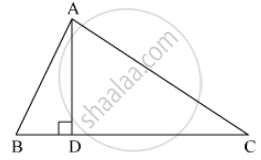
Two trains leave a railway station at the same time. The first train travels due west and the second train due north. The first train travels at a speed of `(20 "km")/"hr"` and the second train travels at `(30 "km")/"hr"`. After 2 hours, what is the distance between them?
If length of sides of a triangle are a, b, c and a2 + b2 = c2, then which type of triangle it is?
The perimeters of two similar triangles ABC and PQR are 60 cm and 36 cm respectively. If PQ = 9 cm, then AB equals ______.
For going to a city B from city A, there is a route via city C such that AC ⊥ CB, AC = 2x km and CB = 2(x + 7) km. It is proposed to construct a 26 km highway which directly connects the two cities A and B. Find how much distance will be saved in reaching city B from city A after the construction of the highway.
In the given figure, AD is a median of a triangle ABC and AM ⊥ BC. Prove that:
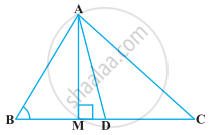
(i) `"AC"^2 = "AD"^2 + "BC"."DM" + (("BC")/2)^2`
(ii) `"AB"^2 = "AD"^2 - "BC"."DM" + (("BC")/2)^2`
(iii) `"AC"^2 + "AB"^2 = 2"AD"^2 + 1/2"BC"^2`
The foot of a ladder is 6 m away from its wall and its top reaches a window 8 m above the ground. Find the length of the ladder.
