Advertisements
Advertisements
Question
Find the Pythagorean triplet from among the following set of numbers.
3, 4, 5
Advertisements
Solution
It is known that, if in a triplet of natural numbers, the square of the biggest number is equal to the sum of the squares of the other two numbers, then the three numbers form a Pythagorean triplet.
The given set of numbers is (3, 4, 5).
The biggest number among the given set is 5.
52 = 25; 42 = 16; 32 = 9
Now, 16 + 9 = 25
∴ 42 + 32 = 52
Thus, (3, 4, 5) form a Pythagorean triplet.
RELATED QUESTIONS
From a point O in the interior of a ∆ABC, perpendicular OD, OE and OF are drawn to the sides BC, CA and AB respectively. Prove
that :
`(i) AF^2 + BD^2 + CE^2 = OA^2 + OB^2 + OC^2 – OD^2 – OE^2 – OF^2`
`(ii) AF^2 + BD^2 + CE^2 = AE^2 + CD^2 + BF^2`
A tree is broken at a height of 5 m from the ground and its top touches the ground at a distance of 12 m from the base of the tree. Find the original height of the tree.
Which of the following can be the sides of a right triangle?
1.5 cm, 2 cm, 2.5 cm
In the case of right-angled triangles, identify the right angles.
Identify, with reason, if the following is a Pythagorean triplet.
(4, 9, 12)
Identify, with reason, if the following is a Pythagorean triplet.
(24, 70, 74)
Find the Pythagorean triplet from among the following set of numbers.
9, 40, 41
A right triangle has hypotenuse p cm and one side q cm. If p - q = 1, find the length of third side of the triangle.
Each side of rhombus is 10cm. If one of its diagonals is 16cm, find the length of the other diagonals.
A man goes 18 m due east and then 24 m due north. Find the distance of his current position from the starting point?
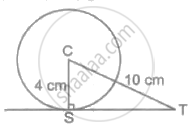
In the adjoining figure, a tangent is drawn to a circle of radius 4 cm and centre C, at the point S. Find the length of the tangent ST, if CT = 10 cm.