Advertisements
Advertisements
Question
In triangle PQR, angle Q = 90°, find: PR, if PQ = 8 cm and QR = 6 cm
Advertisements
Solution
Given:
PQ = 8 cm
QR = 6 cm
PR =?
∠PQR = 90°

According to Pythagoras Theorem,
(PR)2 = (PQ)2 + (QR)2
PR2 = 82 + 62
PR2 = 64 + 36
PR2 = 100
∴ PR = `sqrt100` = 10 cm
APPEARS IN
RELATED QUESTIONS
From a point O in the interior of a ∆ABC, perpendicular OD, OE and OF are drawn to the sides BC, CA and AB respectively. Prove
that :
`(i) AF^2 + BD^2 + CE^2 = OA^2 + OB^2 + OC^2 – OD^2 – OE^2 – OF^2`
`(ii) AF^2 + BD^2 + CE^2 = AE^2 + CD^2 + BF^2`
Two poles of heights 6 m and 11 m stand on a plane ground. If the distance between the feet of the poles is 12 m, find the distance between their tops.
In ∆ABC, seg AD ⊥ seg BC, DB = 3CD.
Prove that: 2AB2 = 2AC2 + BC2

In an isosceles triangle ABC; AB = AC and D is the point on BC produced.
Prove that: AD2 = AC2 + BD.CD.
Find the length of diagonal of the square whose side is 8 cm.
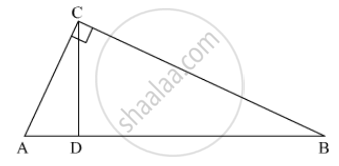
In Fig. 3, ∠ACB = 90° and CD ⊥ AB, prove that CD2 = BD x AD.
Prove that `(sin θ + cosec θ)^2 + (cos θ + sec θ)^2 = 7 + tan^2 θ + cot^2 θ`.
Prove that (1 + cot A - cosec A ) (1 + tan A + sec A) = 2
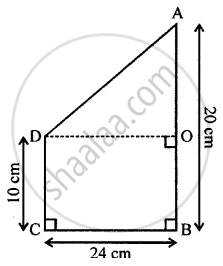
Use the information given in the figure to find the length AD.
Prove that the area of the semicircle drawn on the hypotenuse of a right angled triangle is equal to the sum of the areas of the semicircles drawn on the other two sides of the triangle.
