Advertisements
Advertisements
Question
ABC is a triangle right angled at C. If AB = 25 cm and AC = 7 cm, find BC.
Advertisements
Solution
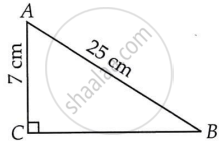
By applying Pythagoras theorem in ΔABC,
(AC)2 + (BC)2 = (AB)2
(BC)2 = (AB)2 − (AC)2
(BC)2 = (25)2 − (7)2
(BC)2 = 625 − 49
(BC)2 = 576
∴ BC = 24 cm
RELATED QUESTIONS
PQR is a triangle right angled at P. If PQ = 10 cm and PR = 24 cm, find QR.
In the given figure, ∆ABC is an equilateral triangle of side 3 units. Find the coordinates of the other two vertices ?
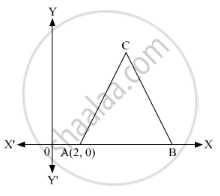
If the angles of a triangle are 30°, 60°, and 90°, then shown that the side opposite to 30° is half of the hypotenuse, and the side opposite to 60° is `sqrt(3)/2` times of the hypotenuse.
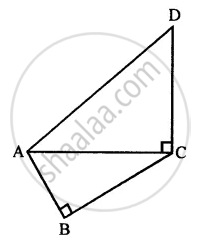
In the given figure, AD = 13 cm, BC = 12 cm, AB = 3 cm and angle ACD = angle ABC = 90°. Find the length of DC.
A man goes 10 m due east and then 24 m due north. Find the distance from the straight point.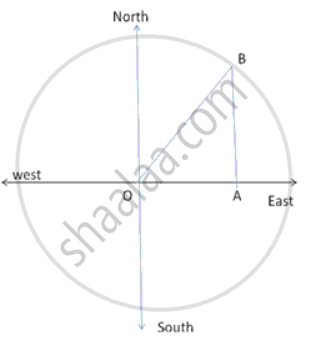
In a triangle ABC, AC > AB, D is the midpoint BC, and AE ⊥ BC. Prove that: AB2 = AD2 - BC x CE + `(1)/(4)"BC"^2`
In a triangle ABC, AC > AB, D is the midpoint BC, and AE ⊥ BC. Prove that: AC2 - AB2 = 2BC x ED
In the given figure, PQ = `"RS"/(3)` = 8cm, 3ST = 4QT = 48cm.
SHow that ∠RTP = 90°.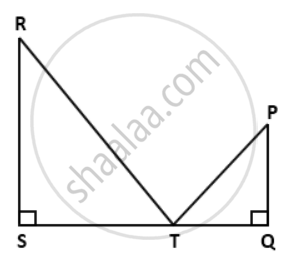
If length of sides of a triangle are a, b, c and a2 + b2 = c2, then which type of triangle it is?
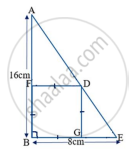
Sides AB and BE of a right triangle, right-angled at B are of lengths 16 cm and 8 cm respectively. The length of the side of largest square FDGB that can be inscribed in the triangle ABE is ______.