Advertisements
Advertisements
Question
In ∆ABC, AB = 10, AC = 7, BC = 9, then find the length of the median drawn from point C to side AB.
Advertisements
Solution
Let CD be the median drawn from the vertex C to side AB.
`"BD" = 1/2 × "AB"` ...(D is the midpoint of AB)
∴ BD = `1/2 × 10`
∴ BD = 5 units
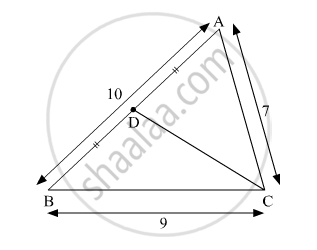
In ∆ABC,
seg CD is the median. ...(Given)
By Apollonius theorem,
∴ AC2 + BC2 = 2CD2 + 2BD2
∴ 72 + 92 = 2CD2 + 2(5)2
∴ 49 + 81 = 2CD2 + 2 × 25
∴ 130 = 2CD2 + 50
∴ 2CD2 = 130 − 50
∴ CD2 = `80/2`
RELATED QUESTIONS
ABCD is a rectangle whose three vertices are B (4, 0), C(4, 3) and D(0,3). The length of one of its diagonals is
(A) 5
(B) 4
(C) 3
(D) 25
If ABC is an equilateral triangle of side a, prove that its altitude = ` \frac { \sqrt { 3 } }{ 2 } a`
The perpendicular AD on the base BC of a ∆ABC intersects BC at D so that DB = 3 CD. Prove that `2"AB"^2 = 2"AC"^2 + "BC"^2`
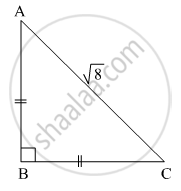
For finding AB and BC with the help of information given in the figure, complete following activity.
AB = BC .......... 
∴ ∠BAC =
∴ AB = BC = × AC
= × `sqrt8`
= × `2sqrt2`
=
Find the length of the hypotenuse of a right angled triangle if remaining sides are 9 cm and 12 cm.
In triangle ABC, given below, AB = 8 cm, BC = 6 cm and AC = 3 cm. Calculate the length of OC.

In equilateral Δ ABC, AD ⊥ BC and BC = x cm. Find, in terms of x, the length of AD.
M andN are the mid-points of the sides QR and PQ respectively of a PQR, right-angled at Q.
Prove that:
(i) PM2 + RN2 = 5 MN2
(ii) 4 PM2 = 4 PQ2 + QR2
(iii) 4 RN2 = PQ2 + 4 QR2(iv) 4 (PM2 + RN2) = 5 PR2
In the right-angled ∆PQR, ∠ P = 90°. If l(PQ) = 24 cm and l(PR) = 10 cm, find the length of seg QR.
A man goes 10 m due east and then 24 m due north. Find the distance from the straight point.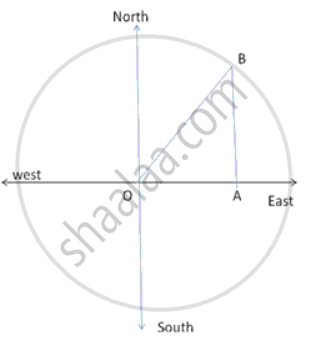
In a triangle ABC right angled at C, P and Q are points of sides CA and CB respectively, which divide these sides the ratio 2 : 1.
Prove that: 9AQ2 = 9AC2 + 4BC2
PQR is an isosceles triangle with PQ = PR = 10 cm and QR = 12 cm. Find the length of the perpendicular from P to QR.
Determine whether the triangle whose lengths of sides are 3 cm, 4 cm, 5 cm is a right-angled triangle.
To get from point A to point B you must avoid walking through a pond. You must walk 34 m south and 41 m east. To the nearest meter, how many meters would be saved if it were possible to make a way through the pond?
The perimeters of two similar triangles ABC and PQR are 60 cm and 36 cm respectively. If PQ = 9 cm, then AB equals ______.
A flag pole 18 m high casts a shadow 9.6 m long. Find the distance of the top of the pole from the far end of the shadow.
If S is a point on side PQ of a ΔPQR such that PS = QS = RS, then ______.
In a quadrilateral ABCD, ∠A + ∠D = 90°. Prove that AC2 + BD2 = AD2 + BC2
[Hint: Produce AB and DC to meet at E.]
Two angles are said to be ______, if they have equal measures.
Points A and B are on the opposite edges of a pond as shown in the following figure. To find the distance between the two points, the surveyor makes a right-angled triangle as shown. Find the distance AB.

