Advertisements
Advertisements
Question
The perimeter of the rectangle whose length is 60 cm and a diagonal is 61 cm is ______.
Options
120 cm
122 cm
71 cm
142 cm
Advertisements
Solution
The perimeter of the rectangle whose length is 60 cm and a diagonal is 61 cm is 142 cm.
Explanation:

Consider the rectangle PQRS,
Given, length of rectangle PQ = 60 cm, Diagonal of the rectangle = 61 cm.
To find out the height of the rectangle, consider the right angled triangle PQR.
From the Pythagoras theorem,
PR2 = PQ2 + RQ2
⇒ 612 = 602 + RQ2
⇒ 3721 = 3600 + RQ2
⇒ RQ2 = 3721 – 3600
⇒ RQ2 = 121
⇒ RQ = `sqrt(121)`
⇒ RQ = 11 cm
Then, the perimeter of the rectangle PQRS = 2(Length + Breadth)
= 2(60 + 11)
= 2(71)
= 142 cm
APPEARS IN
RELATED QUESTIONS
If the sides of a triangle are 6 cm, 8 cm and 10 cm, respectively, then determine whether the triangle is a right angle triangle or not.
ABCD is a rhombus. Prove that AB2 + BC2 + CD2 + DA2= AC2 + BD2
PQR is a triangle right angled at P and M is a point on QR such that PM ⊥ QR. Show that PM2 = QM . MR
In the following figure, O is a point in the interior of a triangle ABC, OD ⊥ BC, OE ⊥ AC and OF ⊥ AB. Show that
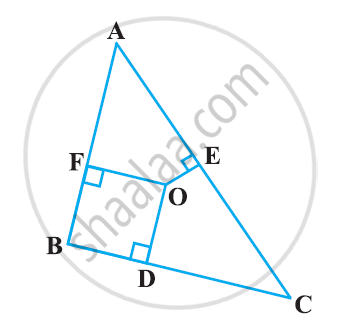
(i) OA2 + OB2 + OC2 − OD2 − OE2 − OF2 = AF2 + BD2 + CE2
(ii) AF2 + BD2 + CE2 = AE2 + CD2 + BF2
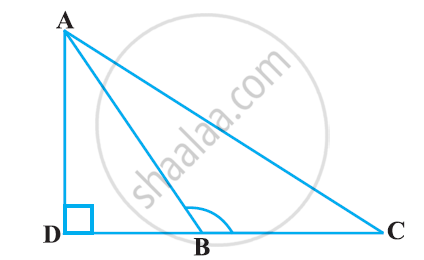
In the given figure, ABC is a triangle in which ∠ABC> 90° and AD ⊥ CB produced. Prove that AC2 = AB2 + BC2 + 2BC.BD.
In the given figure, AB//CD, AB = 7 cm, BD = 25 cm and CD = 17 cm;
find the length of side BC.
AD is drawn perpendicular to base BC of an equilateral triangle ABC. Given BC = 10 cm, find the length of AD, correct to 1 place of decimal.
The sides of the triangle are given below. Find out which one is the right-angled triangle?
8, 15, 17
Lengths of sides of a triangle are 3 cm, 4 cm and 5 cm. The triangle is ______.
Jayanti takes shortest route to her home by walking diagonally across a rectangular park. The park measures 60 metres × 80 metres. How much shorter is the route across the park than the route around its edges?
