Advertisements
Advertisements
Question
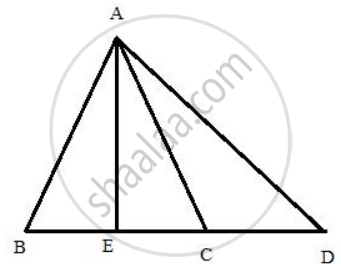
In an isosceles triangle ABC; AB = AC and D is the point on BC produced.
Prove that: AD2 = AC2 + BD.CD.
Advertisements
Solution

In an isosceles triangle ABC; AB = AC and
D is the point on BC produced.
Construct AE perpendicular BC.
Pythagoras theorem states that in a right-angled triangle, the square on the hypotenuse is equal to the sum of the squares on the remaining two sides.
We consider the rt. angled ΔAED and applying Pythagoras theorem we get,
AD2 = AE2 + ED2
AD2 = AE2 + (EC + CD)2 ...(i) [∵ ED = EC + CD]
Similarly, in ΔAEC,
AC2 = AE2 + EC2
AE2 = AC2 - EC2 ...(ii)
From equation (ii)
AD2 = AC2 - EC2 + (EC + CD)2
AD2 = AC2 - EC2 + EC2 + CD2 + 2EC·CD
AD2 = AC2 + CD (CD + 2EC)
AD2 = AC2 + CD (CD + BC)
AD2 = AC2 + CD·BD
Hence, proved.
APPEARS IN
RELATED QUESTIONS
In figure, ∠B of ∆ABC is an acute angle and AD ⊥ BC, prove that AC2 = AB2 + BC2 – 2BC × BD
A guy wire attached to a vertical pole of height 18 m is 24 m long and has a stake attached to the other end. How far from the base of the pole should the stake be driven so that the wire will be taut?
An aeroplane leaves an airport and flies due north at a speed of 1,000 km per hour. At the same time, another aeroplane leaves the same airport and flies due west at a speed of 1,200 km per hour. How far apart will be the two planes after `1 1/2` hours?
Two poles of heights 6 m and 11 m stand on a plane ground. If the distance between the feet of the poles is 12 m, find the distance between their tops.
In an equilateral triangle, prove that three times the square of one side is equal to four times the square of one of its altitudes.
In the given figure, ABC is a triangle in which ∠ABC> 90° and AD ⊥ CB produced. Prove that AC2 = AB2 + BC2 + 2BC.BD.

The diagonals of a rhombus measure 16 cm and 30 cm. Find its perimeter.
The perimeter of a triangle with vertices (0, 4), (0, 0) and (3, 0) is
(A)\[7 + \sqrt{5}\]
(B) 5
(C) 10
(D) 12
A man goes 40 m due north and then 50 m due west. Find his distance from the starting point.
In equilateral Δ ABC, AD ⊥ BC and BC = x cm. Find, in terms of x, the length of AD.
Diagonals of rhombus ABCD intersect each other at point O.
Prove that: OA2 + OC2 = 2AD2 - `"BD"^2/2`
Find the length of diagonal of the square whose side is 8 cm.
Find the Pythagorean triplet from among the following set of numbers.
2, 4, 5
From the given figure, find the length of hypotenuse AC and the perimeter of ∆ABC.
In a triangle ABC, AC > AB, D is the midpoint BC, and AE ⊥ BC. Prove that: AB2 = AD2 - BC x CE + `(1)/(4)"BC"^2`
∆ABC is right-angled at C. If AC = 5 cm and BC = 12 cm. find the length of AB.
In figure, PQR is a right triangle right angled at Q and QS ⊥ PR. If PQ = 6 cm and PS = 4 cm, find QS, RS and QR.
If the areas of two circles are the same, they are congruent.
The hypotenuse (in cm) of a right angled triangle is 6 cm more than twice the length of the shortest side. If the length of third side is 6 cm less than thrice the length of shortest side, then find the dimensions of the triangle.
Jiya walks 6 km due east and then 8 km due north. How far is she from her starting place?