English

In the Figure Ab = Bc and Ad is Perpendicular to Cd. Prove That: Ac2 = 2bc. Dc. - Mathematics

Advertisements
Advertisements

Question

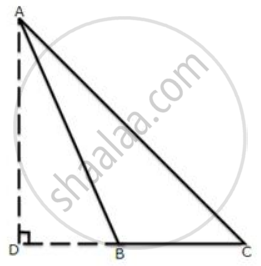
In figure AB = BC and AD is perpendicular to CD.
Prove that: AC2 = 2BC. DC.
Sum
Advertisements

Solution

Pythagoras theorem states that in a right-angled triangle, the square on the hypotenuse is equal to the sum of the squares on the remaining two sides.

We consider the ΔACD and applying Pythagoras theorem we get,
AC2 = AD2 + DC2
= ( AB2 - DB2 ) + ( DB + BC )2
= BC2 - DB2 + DB2 + BC2 + 2DB.BC    ...( Given, AB = BC )
= 2BC2 + 2DB.BC
= 2BC( BC + DB )
= 2BC . DC
Hence proved.

shaalaa.com
  Is there an error in this question or solution?
Chapter 13: Pythagoras Theorem [Proof and Simple Applications with Converse] - Exercise 13 (B) [Page 164]

APPEARS IN

Selina Concise Mathematics [English] Class 9 ICSE
Chapter 13 Pythagoras Theorem [Proof and Simple Applications with Converse]
Exercise 13 (B) | Q 11 | Page 164

RELATED QUESTIONS

The diagonal of a rectangular field is 16 metres more than the shorter side. If the longer side is 14 metres more than the shorter side, then find the lengths of the sides of the field.


In a right triangle ABC, right-angled at B, BC = 12 cm and AB = 5 cm. The radius of the circle inscribed in the triangle (in cm) is
(A) 4
(B) 3
(C) 2
(D) 1


In an equilateral triangle ABC, D is a point on side BC such that BD = `1/3BC` . Prove that 9 AD2 = 7 AB2


Identify, with reason, if the following is a Pythagorean triplet.
(3, 5, 4)


Identify, with reason, if the following is a Pythagorean triplet.
(4, 9, 12)


In an isosceles triangle, length of the congruent sides is 13 cm and its base is 10 cm. Find the distance between the vertex opposite the base and the centroid.


In equilateral Δ ABC, AD ⊥ BC and BC = x cm. Find, in terms of x, the length of AD.


ABC is a triangle, right-angled at B. M is a point on BC.

Prove that: AM2 + BC2 = AC2 + BM2


M andN are the mid-points of the sides QR and PQ respectively of a PQR, right-angled at Q.
Prove that:
(i) PM2 + RN2 = 5 MN2
(ii) 4 PM2 = 4 PQ2 + QR2
(iii) 4 RN2 = PQ2 + 4 QR2(iv) 4 (PM2 + RN2) = 5 PR2


In ∆ ABC, AD ⊥ BC.
Prove that  AC2 = AB2 +BC2 − 2BC x BD


The sides of the triangle are given below. Find out which one is the right-angled triangle?

1.5, 1.6, 1.7


A man goes 10 m due east and then 24 m due north. Find the distance from the straight point.


In a triangle ABC, AC > AB, D is the midpoint BC, and AE ⊥ BC. Prove that: AC2 = AD2 + BC x DE + `(1)/(4)"BC"^2`


Determine whether the triangle whose lengths of sides are 3 cm, 4 cm, 5 cm is a right-angled triangle.


Find the length of the support cable required to support the tower with the floor


In the figure, find AR


In the given figure, ∠T and ∠B are right angles. If the length of AT, BC and AS (in centimeters) are 15, 16, and 17 respectively, then the length of TC (in centimeters) is ______.


A flag pole 18 m high casts a shadow 9.6 m long. Find the distance of the top of the pole from the far end of the shadow.


If the hypotenuse of one right triangle is equal to the hypotenuse of another right triangle, then the triangles are congruent.


Share
Notifications

Englishहिंदीमराठी


      Forgot password?
Use app×