English

A Man Goes 10 M Due East and Then 24 M Due North. Find the Distance from the Straight Point. - Mathematics

Advertisements
Advertisements

Question

A man goes 10 m due east and then 24 m due north. Find the distance from the straight point.
Sum
Advertisements

Solution

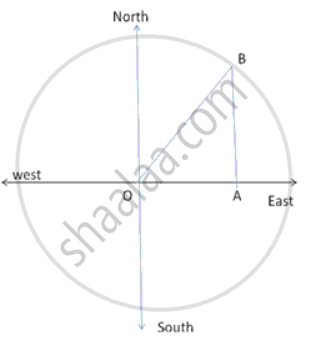
Let O be the original position of the man.
From the figure, it is clear that B is the final position of the man.
ΔAOB is right-angled at A.
By Pythagoras theorem,
OB2 = OA2 + AB2
OB2 = (10m)2 + (24m)2
OB2 = 100m2 + 576m2
OB2 = 676m2
OB2 = (26m)2
OB = 26m
Thus, the man is at a distance of 26m from the straight point.

shaalaa.com
  Is there an error in this question or solution?
Chapter 17: Pythagoras Theorem - Exercise 17.1

APPEARS IN

Frank Mathematics [English] Class 9 ICSE
Chapter 17 Pythagoras Theorem
Exercise 17.1 | Q 4

RELATED QUESTIONS

If the sides of a triangle are 6 cm, 8 cm and 10 cm, respectively, then determine whether the triangle is a right angle triangle or not.


In triangle ABC, ∠C=90°. Let BC= a, CA= b, AB= c and let 'p' be the length of the perpendicular from 'C' on AB, prove that:

1. cp = ab

2. `1/p^2=1/a^2+1/b^2`


Sides of triangles are given below. Determine it is a right triangles? In case of a right triangle, write the length of its hypotenuse. 3 cm, 8 cm, 6 cm


PQR is a triangle right angled at P and M is a point on QR such that PM ⊥ QR. Show that PM2 = QM . MR


In the given figure, ABC is a triangle in which ∠ABC < 90° and AD ⊥ BC. Prove that AC2 = AB2 + BC2 − 2BC.BD.


The diagonals of a rhombus measure 16 cm and 30 cm. Find its perimeter.


The perimeter of a triangle with vertices (0, 4), (0, 0) and (3, 0) is

(A)\[7 + \sqrt{5}\]
(B) 5
(C) 10
(D) 12


Identify, with reason, if the following is a Pythagorean triplet.
(11, 60, 61)


In the given figure, ∠DFE = 90°, FG ⊥ ED, If GD = 8, FG = 12, find (1) EG (2) FD and (3) EF


Find the length of the hypotenuse of a right angled triangle if remaining sides are 9 cm and 12 cm.


A ladder 13 m long rests against a vertical wall. If the foot of the ladder is 5 m from the foot of the wall, find the distance of the other end of the ladder from the ground.


In a triangle ABC, AC > AB, D is the midpoint BC, and AE ⊥ BC. Prove that: AC2 = AD2 + BC x DE + `(1)/(4)"BC"^2`


In the given figure. PQ = PS, P =R = 90°. RS = 20 cm and QR = 21 cm. Find the length of PQ correct to two decimal places.


In the figure, find AR


From given figure, In ∆ABC, If AC = 12 cm. then AB =?


Activity: From given figure, In ∆ABC, ∠ABC = 90°, ∠ACB = 30°

∴ ∠BAC = `square`

∴ ∆ABC is 30° – 60° – 90° triangle

∴ In ∆ABC by property of 30° – 60° – 90° triangle.

∴ AB = `1/2` AC and `square` = `sqrt(3)/2` AC

∴ `square` = `1/2 xx 12` and BC = `sqrt(3)/2 xx 12`

∴ `square` = 6 and BC = `6sqrt(3)`


Sides AB and BE of a right triangle, right-angled at B are of lengths 16 cm and 8 cm respectively. The length of the side of largest square FDGB that can be inscribed in the triangle ABE is ______.


A flag pole 18 m high casts a shadow 9.6 m long. Find the distance of the top of the pole from the far end of the shadow.


In the adjoining figure, a tangent is drawn to a circle of radius 4 cm and centre C, at the point S. Find the length of the tangent ST, if CT = 10 cm.


The perimeter of the rectangle whose length is 60 cm and a diagonal is 61 cm is ______.


If the hypotenuse of one right triangle is equal to the hypotenuse of another right triangle, then the triangles are congruent.


Share
Notifications

Englishहिंदीमराठी


      Forgot password?
Use app×