हिंदी

In an isosceles triangle ABC; AB = AC and D is the point on BC produced. Prove that: AD2 = AC2 + BD.CD. - Mathematics

Advertisements
Advertisements

प्रश्न

In an isosceles triangle ABC; AB = AC and D is the point on BC produced.

Prove that: AD2 = AC2 + BD.CD.

योग
Advertisements

उत्तर
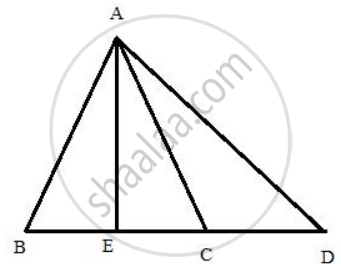

In an isosceles triangle ABC; AB = AC and

D is the point on BC produced. 

Construct AE perpendicular BC.

Pythagoras theorem states that in a right-angled triangle, the square on the hypotenuse is equal to the sum of the squares on the remaining two sides.

We consider the rt. angled ΔAED and applying Pythagoras theorem we get,

AD2 = AE2 + ED2

AD2 = AE2 + (EC + CD)2             ...(i) [∵ ED = EC + CD]

Similarly, in ΔAEC,

AC2 = AE2 + EC2

AE2 = AC2 - EC2                       ...(ii)

From equation (ii)

AD2 = AC2 - EC2 + (EC + CD)2

AD2 = AC2 - EC2 + EC2 + CD2 + 2EC·CD

AD2 = AC2 + CD (CD + 2EC)

AD2 = AC2 + CD (CD + BC)

AD2 = AC2 + CD·BD

Hence, proved.

shaalaa.com
  क्या इस प्रश्न या उत्तर में कोई त्रुटि है?
अध्याय 13: Pythagoras Theorem [Proof and Simple Applications with Converse] - Exercise 13 (B) [पृष्ठ १६४]

APPEARS IN

सेलिना Concise Mathematics [English] Class 9 ICSE
अध्याय 13 Pythagoras Theorem [Proof and Simple Applications with Converse]
Exercise 13 (B) | Q 12 | पृष्ठ १६४

संबंधित प्रश्न

ABCD is a rectangle whose three vertices are B (4, 0), C(4, 3) and D(0,3). The length of one of its diagonals is 
(A) 5
(B) 4
(C) 3
(D) 25


In a ∆ABC, AD ⊥ BC and AD2 = BC × CD. Prove ∆ABC is a right triangle


In an equilateral triangle, prove that three times the square of one side is equal to four times the square of one of its altitudes.


Identify, with reason, if the following is a Pythagorean triplet.
(10, 24, 27)


In ∆PQR, point S is the midpoint of side QR. If PQ = 11, PR = 17, PS = 13, find QR.


In ∆ABC, seg AD ⊥ seg BC, DB = 3CD.

Prove that: 2AB= 2AC+ BC2


In the following figure, AD is perpendicular to BC and D divides BC in the ratio 1: 3.

Prove that : 2AC2 = 2AB2 + BC2


In the following figure, OP, OQ, and OR are drawn perpendiculars to the sides BC, CA and AB respectively of triangle ABC.

Prove that: AR2 + BP2 + CQ2 = AQ2 + CP2 + BR2


Find the side of the square whose diagonal is `16sqrt(2)` cm.


In Fig. 3, ∠ACB = 90° and CD ⊥ AB, prove that CD2 = BD x AD.


A boy first goes 5 m due north and then 12 m due east. Find the distance between the initial and the final position of the boy.


In the right-angled ∆PQR, ∠ P = 90°. If l(PQ) = 24 cm and l(PR) = 10 cm, find the length of seg QR.


Find the Pythagorean triplet from among the following set of numbers.

2, 6, 7


In a triangle ABC right angled at C, P and Q are points of sides CA and CB respectively, which divide these sides the ratio 2 : 1.
Prove that : 9(AQ2 + BP2) = 13AB2 


An isosceles triangle has equal sides each 13 cm and a base 24 cm in length. Find its height


The hypotenuse of a right angled triangle of sides 12 cm and 16 cm is __________


In the given figure, ∠T and ∠B are right angles. If the length of AT, BC and AS (in centimeters) are 15, 16, and 17 respectively, then the length of TC (in centimeters) is ______.


In a quadrilateral ABCD, ∠A + ∠D = 90°. Prove that AC2 + BD2 = AD2 + BC2 

[Hint: Produce AB and DC to meet at E.]


If two legs of a right triangle are equal to two legs of another right triangle, then the right triangles are congruent.


Jiya walks 6 km due east and then 8 km due north. How far is she from her starting place?


Share
Notifications

Englishहिंदीमराठी


      Forgot password?
Use app×