Advertisements
Advertisements
Question
In a triangle, sum of squares of two sides is equal to the square of the third side.
Options
True
False
Advertisements
Solution
This statement is False.
Explanation:
In a right-angled triangle, the sum of squares of two sides is equal to the square of the third side.
APPEARS IN
RELATED QUESTIONS
If ABC is an equilateral triangle of side a, prove that its altitude = ` \frac { \sqrt { 3 } }{ 2 } a`
Prove that, in a right-angled triangle, the square of the hypotenuse is equal to the sum of the square of remaining two sides.
Digonals of parallelogram WXYZ intersect at point O. If OY =5, find WY.
Diagonals of rhombus ABCD intersect each other at point O.
Prove that: OA2 + OC2 = 2AD2 - `"BD"^2/2`
Find the length of the perpendicular of a triangle whose base is 5cm and the hypotenuse is 13cm. Also, find its area.
A man goes 10 m due east and then 24 m due north. Find the distance from the straight point.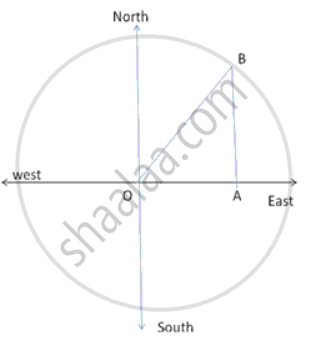
In the given figure, PQ = `"RS"/(3)` = 8cm, 3ST = 4QT = 48cm.
SHow that ∠RTP = 90°.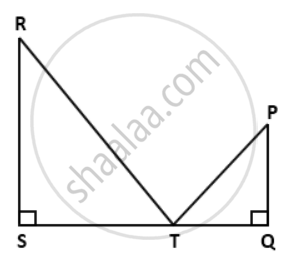
Determine whether the triangle whose lengths of sides are 3 cm, 4 cm, 5 cm is a right-angled triangle.
Find the length of the support cable required to support the tower with the floor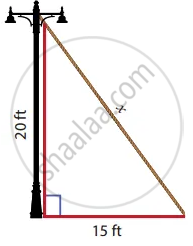
The hypotenuse (in cm) of a right angled triangle is 6 cm more than twice the length of the shortest side. If the length of third side is 6 cm less than thrice the length of shortest side, then find the dimensions of the triangle.
