English
Maharashtra State BoardSSC (English Medium) 10th Standard

In a right angled triangle, if length of hypotenuse is 25 cm and height is 7 cm, then what is the length of its base?

Advertisements
Advertisements

Question

In a right angled triangle, if length of hypotenuse is 25 cm and height is 7 cm, then what is the length of its base?

Sum
Advertisements

Solution
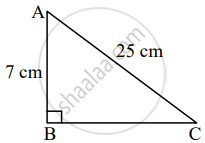

Let ∆ABC be the given right angled triangle.

AC = 25 cm, AB = 7 cm

In ∆ABC, ∠B = 90°   ...[Given]

∴ AC2 = AB2 + BC2    ...[Pythagoras theorem]

∴ 252 = 72 + BC2

∴ 625 = 49 + BC2

∴ BC2 = 625 – 49

∴ BC2 = 576

∴ BC = 24 cm   ...[Taking square root of both sides]

∴ The length of the base of the given right angle triangle is 24 cm.

shaalaa.com
  Is there an error in this question or solution?
Chapter 2: Pythagoras Theorem - Exercise

APPEARS IN

Video TutorialsVIEW ALL [1]

RELATED QUESTIONS

In a right triangle ABC, right-angled at B, BC = 12 cm and AB = 5 cm. The radius of the circle inscribed in the triangle (in cm) is ______.


Prove that the diagonals of a rectangle ABCD, with vertices A(2, -1), B(5, -1), C(5, 6) and D(2, 6), are equal and bisect each other.


In the given figure, ∆ABC is an obtuse triangle, obtuse-angled at B. If AD ⊥ CB (produced) prove that AC2 = AB2 + BC2 + 2BC · BD.


P and Q are the mid-points of the sides CA and CB respectively of a ∆ABC, right angled at C. Prove that:

`(i) 4AQ^2 = 4AC^2 + BC^2`

`(ii) 4BP^2 = 4BC^2 + AC^2`

`(iii) (4AQ^2 + BP^2 ) = 5AB^2`


In the given figure, ABC is a triangle in which ∠ABC < 90° and AD ⊥ BC. Prove that AC2 = AB2 + BC2 − 2BC.BD.


Which of the following can be the sides of a right triangle?

2 cm, 2 cm, 5 cm

In the case of right-angled triangles, identify the right angles.


The diagonals of a rhombus measure 16 cm and 30 cm. Find its perimeter.


For finding AB and BC with the help of information given in the figure, complete following activity.

AB = BC ..........

∴ ∠BAC =

∴ AB = BC = × AC

                 = × `sqrt8`

                 = × `2sqrt2`

                 =


In equilateral Δ ABC, AD ⊥ BC and BC = x cm. Find, in terms of x, the length of AD.


In an isosceles triangle ABC; AB = AC and D is the point on BC produced.

Prove that: AD2 = AC2 + BD.CD.


Diagonals of rhombus ABCD intersect each other at point O.

Prove that: OA2 + OC2 = 2AD2 - `"BD"^2/2`


In a rectangle ABCD,
prove that: AC2 + BD2 = AB2 + BC2 + CD2 + DA2.


In Fig. 3, ∠ACB = 90° and CD ⊥ AB, prove that CD2 = BD x AD.


Show that the triangle ABC is a right-angled triangle; if: AB = 9 cm, BC = 40 cm and AC = 41 cm


In the figure below, find the value of 'x'.


A point OI in the interior of a rectangle ABCD is joined with each of the vertices A, B, C and D. Prove that  OB2 + OD2 = OC2 + OA2


A man goes 18 m due east and then 24 m due north. Find the distance of his current position from the starting point?


There are two paths that one can choose to go from Sarah’s house to James's house. One way is to take C street, and the other way requires to take B street and then A street. How much shorter is the direct path along C street?


If length of sides of a triangle are a, b, c and a2 + b2 = c2, then which type of triangle it is?


Two poles of 10 m and 15 m stand upright on a plane ground. If the distance between the tops is 13 m, find the distance between their feet.


Share
Notifications

Englishहिंदीमराठी


      Forgot password?
Use app×