Advertisements
Advertisements
Question
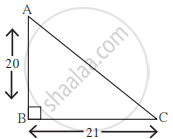
From the given figure, find the length of hypotenuse AC and the perimeter of ∆ABC.
Advertisements
Solution
Given here is a right-angled triangle. So, we can apply Pythagoras’s theorem.
AB2 + BC2 = AC2
⇒ 202 + 212 = AC2
⇒ AC2 = 400 + 441
= 841
⇒ AC = 29
Thus, the length of the hypotenuse is 29 units.
Perimeter of ∆ABC = AB + BC + CA =
20 + 21 + 29
= 70 units.
APPEARS IN
RELATED QUESTIONS
In a right triangle ABC, right-angled at B, BC = 12 cm and AB = 5 cm. The radius of the circle inscribed in the triangle (in cm) is ______.
A ladder leaning against a wall makes an angle of 60° with the horizontal. If the foot of the ladder is 2.5 m away from the wall, find the length of the ladder
The diagonals of a rhombus measure 16 cm and 30 cm. Find its perimeter.
A man goes 40 m due north and then 50 m due west. Find his distance from the starting point.
In a quadrilateral ABCD, ∠B = 90° and ∠D = 90°.
Prove that: 2AC2 - AB2 = BC2 + CD2 + DA2
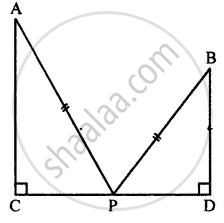
In the given figure, angle ACP = ∠BDP = 90°, AC = 12 m, BD = 9 m and PA= PB = 15 m. Find:
(i) CP
(ii) PD
(iii) CD
Find the length of the perpendicular of a triangle whose base is 5cm and the hypotenuse is 13cm. Also, find its area.
If ΔABC ~ ΔPQR, `("ar" triangle "ABC")/("ar" triangle "PQR") = 9/4` and AB = 18 cm, then the length of PQ is ______.
For going to a city B from city A, there is a route via city C such that AC ⊥ CB, AC = 2x km and CB = 2(x + 7) km. It is proposed to construct a 26 km highway which directly connects the two cities A and B. Find how much distance will be saved in reaching city B from city A after the construction of the highway.
The hypotenuse (in cm) of a right angled triangle is 6 cm more than twice the length of the shortest side. If the length of third side is 6 cm less than thrice the length of shortest side, then find the dimensions of the triangle.
