Advertisements
Advertisements
प्रश्न
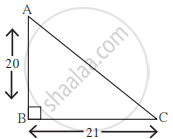
From the given figure, find the length of hypotenuse AC and the perimeter of ∆ABC.
Advertisements
उत्तर
Given here is a right-angled triangle. So, we can apply Pythagoras’s theorem.
AB2 + BC2 = AC2
⇒ 202 + 212 = AC2
⇒ AC2 = 400 + 441
= 841
⇒ AC = 29
Thus, the length of the hypotenuse is 29 units.
Perimeter of ∆ABC = AB + BC + CA =
20 + 21 + 29
= 70 units.
APPEARS IN
संबंधित प्रश्न
Sides of triangle are given below. Determine it is a right triangle or not? In case of a right triangle, write the length of its hypotenuse. 50 cm, 80 cm, 100 cm
Find the side and perimeter of a square whose diagonal is 10 cm.
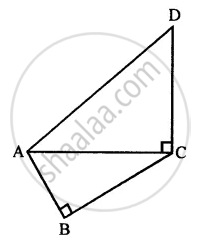
In the given figure, AD = 13 cm, BC = 12 cm, AB = 3 cm and angle ACD = angle ABC = 90°. Find the length of DC.
Find the Pythagorean triplet from among the following set of numbers.
9, 40, 41
Find the Pythagorean triplet from among the following set of numbers.
4, 7, 8
The sides of the triangle are given below. Find out which one is the right-angled triangle?
11, 60, 61
The sides of the triangle are given below. Find out which one is the right-angled triangle?
1.5, 1.6, 1.7
Determine whether the triangle whose lengths of sides are 3 cm, 4 cm, 5 cm is a right-angled triangle.
An isosceles triangle has equal sides each 13 cm and a base 24 cm in length. Find its height
The longest side of a right angled triangle is called its ______.
