Advertisements
Advertisements
Question
Two poles of 10 m and 15 m stand upright on a plane ground. If the distance between the tops is 13 m, find the distance between their feet.
Advertisements
Solution

Let BC = x m
In right-angled ΔACB,
AB2 = AC2 + BC2 ...[By Pythagoras theorem]
⇒ (13)2 = (5)2 + x2
⇒ 169 – 25 = x2
⇒ 144 = x2
⇒ x = `sqrt(144)`
⇒ x = 12 m
Hence, the distance between the feet of two poles is 12 m.
APPEARS IN
RELATED QUESTIONS
In a right triangle ABC, right-angled at B, BC = 12 cm and AB = 5 cm. The radius of the circle inscribed in the triangle (in cm) is ______.
ABC is a right triangle right-angled at C. Let BC = a, CA = b, AB = c and let p be the length of perpendicular from C on AB, prove that
(i) cp = ab
`(ii) 1/p^2=1/a^2+1/b^2`
In an equilateral triangle, prove that three times the square of one side is equal to four times the square of one of its altitudes.
The given figure shows a quadrilateral ABCD in which AD = 13 cm, DC = 12 cm, BC = 3 cm and ∠ABD = ∠BCD = 90o. Calculate the length of AB.
O is any point inside a rectangle ABCD.
Prove that: OB2 + OD2 = OC2 + OA2.
Prove that (1 + cot A - cosec A ) (1 + tan A + sec A) = 2
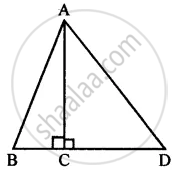
In the given figure, angle ACB = 90° = angle ACD. If AB = 10 m, BC = 6 cm and AD = 17 cm, find :
(i) AC
(ii) CD
In a triangle ABC right angled at C, P and Q are points of sides CA and CB respectively, which divide these sides the ratio 2 : 1.
Prove that: 9AQ2 = 9AC2 + 4BC2
Find the length of the support cable required to support the tower with the floor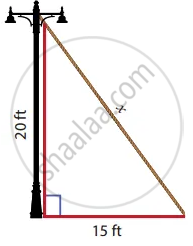
In a right-angled triangle ABC, if angle B = 90°, then which of the following is true?
